The Battle of the Overpass — May 26, 1937
On the afternoon of May 26, 1937, four men in suits climbed the Miller Road overpass outside the Ford River Rouge Complex. They carried leaflets. They had tipped off a photographer.
Walter Reuther, a 29-year-old United Auto Workers organizer who would later become the most powerful labor leader in American history, reached the top of the overpass first. He and three fellow organizers — Richard Frankensteen, Robert Kanter, and Ralph Dunham — posed for the camera of James Kilpatrick, a Detroit News photographer stationed below. The leaflets read: “Unionism, not Fordism.” They had been standing there for less than a minute when the beating began.
Forty men from Ford’s Service Department — the company’s private security force, staffed almost entirely with ex-boxers, ex-convicts, and professional intimidators — appeared from behind. They grabbed Frankensteen first, pinning his arms and slamming his head into the concrete. They pulled Reuther’s jacket over his head so he couldn’t see the fists, then threw him down the steel steps of the overpass. When he got up, they threw him down again. They kicked him in the kidneys, the groin, the face. They broke Frankensteen’s back across the railing. They beat every organizer on the overpass, then turned on the women distributing leaflets at the base of the stairs, knocking several to the ground.
Kilpatrick kept shooting. When Bennett’s men came for his camera, he surrendered it — but he had already hidden the exposed plates inside his car. By the next morning, photographs of Reuther and Frankensteen, bloodied and battered in their torn suits, ran on front pages across the country.
The Rouge Complex was the most technologically advanced factory ever built. It was also the proof that industrial progress, left unchecked by democratic accountability, will devour the people who build it. Henry Ford did not merely resist unions. He constructed a private police state inside an American city — a parallel authority with its own spies, its own enforcers, its own jails — and maintained it for two decades while the rest of the country watched, largely in silence. The Rouge’s story is not a parable about the cost of progress. It is a case study in what happens when a single man controls the livelihoods of a hundred thousand people and answers to no one.
How Henry Ford Built the World’s Largest Factory
From Highland Park to the Rouge River
Ford broke ground on the Rouge Complex in 1917, driven by a single obsession: total control. His Highland Park plant, where the moving assembly line had been perfected three years earlier, depended on outside suppliers for steel, glass, rubber, and dozens of other materials. Ford hated the dependency. He wanted a factory where raw materials entered at one end — iron ore from his own mines in Minnesota, rubber from his own plantations, coal from his own fields in Kentucky and West Virginia — and finished automobiles emerged at the other, without a single component passing through another company’s hands.
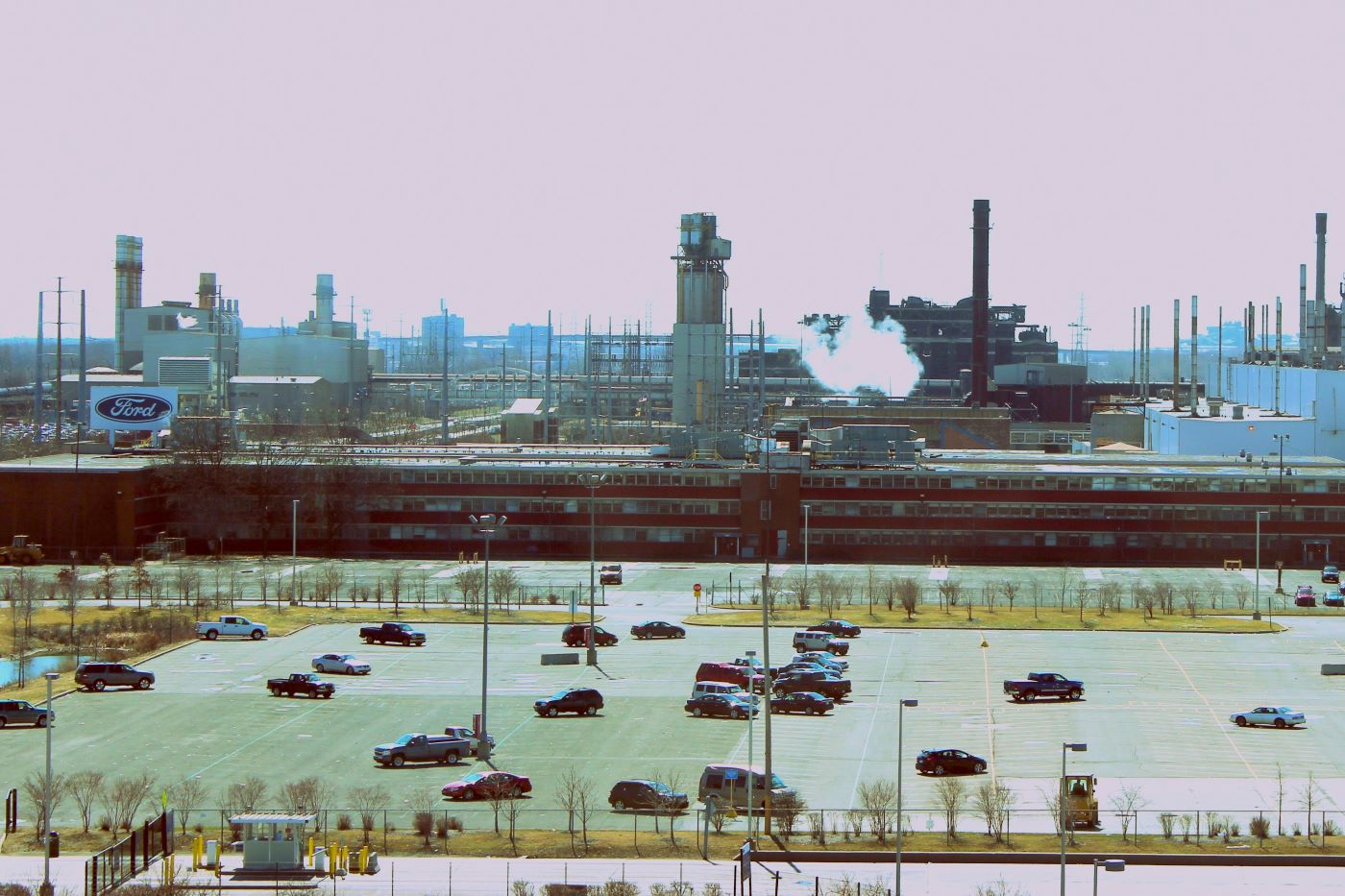
The scale of what he built had no precedent. By 1928, the Rouge Complex sprawled across 2,000 acres along the Rouge River in Dearborn, Michigan. It contained 93 buildings connected by 120 miles of conveyors and 100 miles of internal railroad track. It had its own steel mill, its own glass plant, its own paper mill, its own cement factory, its own power station generating enough electricity for a city of 500,000. Freighters carrying ore docked at its own deep-water port on the Rouge River. The complex consumed more raw materials per day than some small nations. At its peak in the late 1930s, more than 100,000 workers passed through its gates every day, making it not just the largest factory in the world but one of the largest single employer sites in human history.
The Rouge did not merely assemble cars. It made the steel, poured the glass, cured the rubber, pressed the body panels, and forged the engine blocks. A chunk of Minnesota iron ore could arrive by ship on Monday morning and leave as part of a finished Model A by Wednesday afternoon. No factory before or since has achieved that degree of vertical integration at that scale. Ford’s obsession with controlling his own rubber supply led him to build an entire company town in the Brazilian Amazon — a project that collapsed under the weight of the same authoritarian impulses that defined the Rouge. The factory was an engineering marvel, and it gave Henry Ford something more valuable than efficiency. It gave him absolute power over every worker, every process, and every dollar inside its walls.
The $5 Day and the Sociological Department
Ford’s most celebrated act of apparent generosity — the announcement in January 1914 that he would pay workers $5 a day, more than double the prevailing wage — was also his most effective tool of control. The $5 day was not a flat wage. It was split: roughly half was base pay, and the other half was a “profit-sharing” bonus conditional on the worker meeting Ford’s personal standards of behavior. To determine who qualified, Ford created the Sociological Department, a force of 50 investigators whose job was to enter workers’ homes, unannounced, and inspect their lives.
The investigators checked whether a man was married. Whether he drank. Whether his house was clean. Whether his wife worked outside the home (Ford disapproved). Whether he had boarders (Ford disapproved of that too). Whether he gambled, or attended radical political meetings, or failed to maintain a savings account. Workers who didn’t pass the inspection lost the bonus half of their wage — and those who continued to fail were fired. The Sociological Department was, in effect, a private moral police force funded by the promise of a paycheck.
The Ford English School extended the program to immigrant workers, who made up a large portion of the Rouge’s labor force. Attendance was mandatory. The curriculum taught English, but it also taught Ford’s version of American identity. The graduation ceremony was a piece of theater that would be difficult to invent: immigrant workers, dressed in their native clothing, walked into a giant prop cauldron labeled “The Melting Pot.” Teachers stirred the pot with oversized ladles. The workers emerged on the other side wearing identical American suits, waving American flags. Their old clothes were left behind. Ford called it Americanization. His workers had another word for it.
Harry Bennett and the Ford Service Department
How Harry Bennett Built Ford’s Private Security Force
Harry Bennett started as Henry Ford’s personal bodyguard in 1916 — a compact, combative ex-Navy boxer who carried a pistol and cultivated a reputation for violence. By the early 1930s, he had become the second most powerful man at Ford Motor Company, commanding a private security force that would grow to more than 3,000 men. Ford gave Bennett a single mandate: keep the unions out.
Bennett recruited accordingly. His Service Department was staffed with ex-prizefighters, released convicts, and men whose primary qualification was a willingness to hurt people. Some had criminal records for assault, armed robbery, or worse. Bennett installed them throughout the Rouge — on the assembly lines, in the parking lots, in the cafeterias — where they watched workers for any sign of union sympathy. A man caught talking to a co-worker about wages could be pulled off the line, taken to a back room, and beaten. A man seen accepting a union leaflet outside the gates could find himself fired by the end of his shift, his name added to a blacklist that would follow him to every other employer in Detroit.
Bennett’s men didn’t limit their methods to intimidation. In one documented incident, Service Department operatives kidnapped a union organizer, drove him to a remote location, and beat him so severely he required hospitalization. In another, they arranged for a worker suspected of union ties to be transferred to the most dangerous section of the foundry — the industrial equivalent of a death sentence by attrition. The violence was systematic, and Ford knew. When a reporter asked Ford about Bennett’s methods in the mid-1930s, Ford replied that Bennett was “a great man” who “takes care of things.”
The Rouge as a Police State
Bennett’s influence extended far beyond the factory walls. He cultivated relationships with Dearborn’s police chief, its mayor, and its judges, effectively merging Ford’s private security apparatus with the city’s public institutions. Dearborn police routinely assisted Bennett’s men in surveilling, harassing, and arresting union organizers — often on Ford property, using Ford resources, with Ford’s explicit blessing. The boundary between corporate security and municipal law enforcement in Dearborn during the Bennett years was, for practical purposes, nonexistent.
Inside the Rouge, the atmosphere was one of pervasive fear. Workers whispered. They avoided eye contact with known Service Department operatives. They did not discuss wages, hours, or working conditions in any space where they might be overheard — which, given the density of Bennett’s network, meant virtually everywhere. A 1937 Senate investigation found that Ford employed more private detectives and labor spies per worker than any other American corporation. The Rouge was not merely a factory with strict management. It was a surveillance state operating inside a democracy, funded by car sales, and answerable to one man.
The Ford Hunger March and the Massacre of 1932
The 1932 Ford Hunger March and the Miller Road Shooting
The Great Depression hit Detroit harder than almost any other American city. By early 1932, Ford had laid off tens of thousands of Rouge workers, many without severance or warning. Unemployment in the Detroit area exceeded 50 percent. Breadlines stretched for blocks. Families who had moved north for Ford’s $5 day found themselves starving in rented rooms, with no income, no savings, and no prospect of rehire.
On March 7, 1932, between 3,000 and 5,000 unemployed workers — many of them former Rouge employees — gathered at a rally organized by the Unemployed Councils, a Communist Party–affiliated group, and began marching from Detroit toward the Rouge Complex. Their demands were modest: jobs, relief payments, and the right to organize. They marched in freezing weather, crossing the Detroit–Dearborn city line in the early afternoon.
At the Dearborn border, they were met by Dearborn police, who fired tear gas into the crowd. The marchers pressed forward. At the Rouge’s Gate 3, on Miller Road, they encountered a second line — Dearborn police and Ford Service Department men, standing together. Someone gave an order. The police and Ford’s men opened fire.
They used pistols. They used a machine gun mounted on a fire truck. They fired into a crowd of unarmed, unemployed workers standing in the cold.
Four men were killed outright: Joe York, 22. Coleman Leny, also known as Joe Bussell, a young autoworker. Joe DeBlasio, 24. Kalman Leny, a Hungarian immigrant. A fifth man, Curtis Williams, 20, died of his wounds weeks later. More than 60 others were wounded, some critically. The dead and injured lay on Miller Road in the slush and mud while Dearborn authorities, working in close coordination with Ford’s security apparatus, moved to suppress the story. No Ford employee or Dearborn police officer was ever charged. The official explanation blamed the marchers — “communist agitators,” the police chief said — and local newspapers largely accepted the company line.
The Mass Funeral and the Radicalization of Detroit Labor
The cover-up failed where it mattered most: in the streets. On March 12, 1932, an estimated 60,000 to 80,000 people marched in the funeral procession for the four dead workers through the streets of Detroit. It was one of the largest public demonstrations in the city’s history. The coffins were draped in red cloth. The mourners sang “The Internationale.” The spectacle radicalized a generation of Detroit workers and transformed the Ford Hunger March from a local tragedy into a national symbol of corporate violence against labor.
The massacre also hardened the resolve of union organizers. The men who would lead the UAW’s campaign against Ford in the late 1930s — Reuther, Frankensteen, and others — cited the 1932 killings as a defining moment. Five years later, they climbed the Miller Road overpass knowing exactly what Ford’s men were capable of.
The Battle of the Overpass and Ford’s Last Stand Against Unions
How the Overpass Photographs Changed Public Opinion
The beating of Reuther and Frankensteen on the Miller Road overpass in May 1937 was not an isolated act of violence — it was the most visible eruption of a policy that Ford had maintained for years. What made it different was the photographs. Kilpatrick’s images, published nationally, showed well-dressed men being beaten by thugs outside a factory that had been celebrated as the pinnacle of American industry. The contradiction was impossible to ignore. The National Labor Relations Board filed charges against Ford for violating the Wagner Act, and a federal investigation confirmed what workers had known for years: the Rouge was a company-run police state where the right to organize was suppressed by force.
Ford denied everything. He claimed the Service Department had acted without authorization, a claim that no one who understood Bennett’s relationship with Ford took seriously. The NLRB ruled against Ford in 1939, ordering the company to cease its anti-union activities. Ford ignored the ruling. He continued to employ Bennett, continued to fund the Service Department, and continued to fire any worker suspected of union membership.
The 1941 Strike That Ended Ford’s Reign
The end came in April 1941. After Ford fired eight union members at the Rouge, the UAW called a strike. More than 50,000 workers walked out, shutting down production entirely. Ford’s initial response was characteristically combative — Bennett’s men attacked picketers with clubs and fire hoses, and Ford publicly vowed never to sign a union contract.
The federal government intervened. With war production looming and the Roosevelt administration unwilling to tolerate a prolonged shutdown of one of America’s largest factories, mediators pressured Ford to negotiate. The decisive blow, according to multiple accounts, came from an unexpected source: Clara Ford, Henry’s wife, who reportedly told her husband she would leave him if he allowed further bloodshed. Whether the threat was genuine or strategic, Ford capitulated. In June 1941, he signed a contract with the UAW that was, ironically, the most generous in the auto industry — a closed shop, dues checkoff, and back pay for fired workers. The man who had held out longest against organized labor gave in most completely.
Henry Ford’s Anti-Semitism and the Nazi Connection
The Dearborn Independent and The International Jew
Henry Ford’s hatred of Jews was not a private prejudice. He industrialized it. In 1920, Ford purchased a small local newspaper, The Dearborn Independent, and used it as a vehicle for one of the most sustained anti-Semitic propaganda campaigns in American history. Over 91 consecutive issues, the paper published articles blaming Jews for controlling international finance, corrupting American culture, undermining Christianity, and engineering World War I. The articles were compiled into a four-volume book titled The International Jew, which was translated into 16 languages and distributed worldwide.
The reach of Ford’s anti-Semitism was extraordinary. In Munich, a young Adolf Hitler kept a portrait of Henry Ford on his office wall and copies of The International Jew on his desk. In Mein Kampf, published in 1925, Hitler cited Ford by name — the only American mentioned in the book — praising him as a fellow fighter against Jewish influence. Ford’s writings did not merely echo Nazi ideology. They helped shape it. Baldur von Schirach, the leader of the Hitler Youth, testified at the Nuremberg trials that he had become an anti-Semite after reading The International Jew at the age of 17.
Ford officially ceased publication of the anti-Semitic articles in 1927, under pressure from a defamation lawsuit and an organized Jewish boycott of Ford automobiles. He issued a public apology — drafted by an intermediary, which Ford signed without reading — but the retraction was widely regarded as hollow. The books continued to circulate. Ford continued to express anti-Semitic views in private. And the damage was already done.
The Grand Cross of the German Eagle
On July 30, 1938, at the German consulate in Detroit, two Nazi diplomats pinned the Grand Cross of the German Eagle to Henry Ford’s chest. It was Nazi Germany’s highest civilian honor for foreigners, and Ford was the first American to receive it. The ceremony took place four months before Kristallnacht, the coordinated nationwide pogrom against German Jews that destroyed thousands of synagogues and businesses and killed nearly 100 people. Ford never returned the medal.
Ford’s relationship with the Third Reich extended beyond ideology. Ford-Werke, the company’s German subsidiary, produced trucks, personnel carriers, and engine components for the Wehrmacht throughout the war. The Cologne plant used forced labor — prisoners of war and concentration camp inmates — to maintain production. After the war, Ford Motor Company successfully lobbied the U.S. government for $1 million in damages for Allied bombing of the Cologne plant, collecting reparations for a factory that had been producing vehicles for the Nazi military using slave labor. The claim was paid.
Race at the Rouge — From the Great Migration to the 1963 Walkout
Black Workers in the Rouge Foundry
During the Great Migration of the 1910s through the 1940s, hundreds of thousands of Black Americans fled the Jim Crow South for industrial jobs in Northern cities — fleeing the same violence that had destroyed Tulsa’s Black Wall Street and dozens of other prosperous Black communities across the South. The Rouge Complex became one of the largest employers of Black workers in America — by the 1940s, roughly 12,000 African Americans worked there, making up more than 10 percent of the total workforce. Ford cultivated this relationship deliberately, channeling jobs through Black ministers and community leaders who, in return, delivered votes and political loyalty. It was a transactional arrangement, and Ford controlled the terms.
The transaction had a visible price. Black workers at the Rouge were overwhelmingly concentrated in the foundry — the hottest, most physically punishing, and most dangerous department in the complex. Temperatures in the foundry regularly exceeded 130°F. The work involved pouring molten metal, breathing particulate-laden air, and handling materials that caused burns, lung disease, and chronic injury. White workers occupied the cleaner, cooler, better-paid positions on the assembly lines. Facilities were segregated. Promotions for Black workers were functionally nonexistent. The Rouge employed Black men in large numbers, but it employed them in the jobs that white men refused to do.
The Wildcat Strike of 1963
On June 3, 1963 — three months before the March on Washington — roughly 4,000 Black workers at the Rouge staged a wildcat strike, walking off the assembly lines to protest racial discrimination in hiring, promotion, and working conditions. The walkout was organized by the Trade Union Leadership Council (TULC), a coalition of Black trade unionists, with support from Reverend Albert Cleage, a prominent Detroit pastor and civil rights leader who would later become a central figure in the Black Power movement. The strike shut down production on several lines and forced Ford management to the negotiating table.
Ford made concessions — modest improvements in promotion pathways and a commitment to review discriminatory practices — but the structural racism at the Rouge persisted for years. The 1963 walkout mattered less for what it achieved in the short term than for what it represented: Black workers refusing to accept the foundry bargain, demanding not just employment but equality, in a factory that had treated their labor as expendable from the beginning. It was one of the earliest industrial actions of the civil rights era to explicitly target workplace racism, and it happened inside the factory that Henry Ford had built as a monument to his own vision of order.
The Rouge After Ford — Decline, Pollution, and Reinvention
Rouge River Pollution and the Factory’s Environmental Legacy
The Rouge River, which gave the complex its name, paid the heaviest long-term price for Ford’s industrial empire. For decades, the factory dumped industrial waste — oil, solvents, heavy metals, chemical runoff — directly into the river with minimal treatment. By the 1960s, the Rouge River was one of the most polluted waterways in the United States. In 1969, the same year that Cleveland’s Cuyahoga River famously caught fire, the Rouge River experienced its own oil-slick fire — a less publicized but equally damning indictment of unchecked industrial pollution.
Cleanup efforts began in the 1970s under pressure from the newly created Environmental Protection Agency, but the damage was vast and the remediation slow. Sediments in the river bottom remain contaminated with PCBs, heavy metals, and petroleum compounds. Ford invested heavily in environmental renovation beginning in the early 2000s, commissioning architect William McDonough to redesign the Dearborn Truck Plant with a 10.4-acre “living roof” — the largest in the world at the time — covered in sedum plants that absorb rainwater and reduce stormwater runoff. The living roof became a symbol of Ford’s environmental commitments, though critics noted the irony of celebrating a green roof on a factory whose operations had poisoned the river beneath it for half a century.
The Rouge Complex’s Decline from 100,000 Workers
The Rouge’s decline mirrored Detroit’s. Foreign competition, automation, and the long-term consequences of Ford’s adversarial relationship with its own workforce eroded the complex’s dominance through the 1970s and 1980s. Production shifted overseas and to non-union plants in the American South. The workforce shrank from its wartime peak of more than 100,000 to fewer than 6,000 today. Entire buildings were demolished. Rail lines rusted. The Rouge became what so many American industrial sites became in the late 20th century: a vast physical footprint with a fraction of the human activity that once justified it.
Ford’s F-150 pickup truck — the best-selling vehicle in America for more than four decades — is still assembled at the Rouge, now at the Dearborn Truck Plant. The company has announced plans for electric vehicle production at the site. The UAW, diminished but not gone, still represents the remaining workers, though the union’s power is a shadow of what Reuther built. Temporary and contract workers, who lack the job security and benefits that the 1941 strike won, make up a growing share of the workforce — a quiet erosion of the gains that cost men their backs, their jobs, and in some cases their lives. The factory that Henry Ford built as a monument to total control is still running, but the empire it anchored is gone.
Visiting the Ford Rouge Complex Today
The Factory Tour and What It Leaves Out
The Ford Rouge Factory Tour is open to the public and offers a carefully curated glimpse of the complex’s past and present. Visitors walk through the F-150 assembly line, where trucks move along the same production path that once built Model As and B-24 bombers. The observation deck atop the Dearborn Truck Plant offers views of McDonough’s living roof and the sprawling industrial landscape beyond. An introductory film, narrated with corporate enthusiasm, emphasizes Ford’s innovations — vertical integration, the assembly line, the $5 day — while compressing the labor conflicts, the anti-Semitism, and the Ford Massacre into brief, carefully worded acknowledgments. More information on visiting the factory today can be found here.
The Miller Road overpass — the site of the 1937 Battle of the Overpass, where Reuther and Frankensteen were beaten while a photographer captured the evidence — is still standing. It is unmarked. No plaque, no historical marker, no acknowledgment that one of the most important moments in American labor history took place on its steps. Visitors who know the history can walk there. Most don’t know to look.
Dearborn and the Surrounding Sites
The Rouge Complex sits within a broader landscape of Ford-related history. The Henry Ford Museum of American Innovation and Greenfield Village, both in Dearborn, house Ford’s personal collection of Americana — Edison’s laboratory, the Wright Brothers’ bicycle shop, the bus where Rosa Parks refused to give up her seat — curated into a narrative of American progress that conveniently frames Ford himself as part of the same tradition. The Rouge River Trail, a paved walking and cycling path, follows the river through restored wetlands that would have been unrecognizable to the workers who breathed the foundry air a generation ago.
Dearborn itself is worth attention. The city’s demographics have shifted dramatically since Ford’s era — it is now home to one of the largest Arab American communities in the United States, a transformation that Ford, who built his empire on a vision of cultural homogeneity enforced by his Sociological Department, could not have anticipated and almost certainly would not have welcomed. The Rouge Complex is best understood not as an isolated site but as the anchor of a landscape shaped entirely by one man’s vision — and by the people who fought to survive inside it.
The Rouge’s story is not finished. The factory still runs. The river is still healing. The overpass is still unmarked. And the question the Rouge has posed since 1917 — who benefits from progress, and who pays for it — has not been answered.
Frequently Asked Questions About the Ford River Rouge Complex
What was the Ford River Rouge Complex?
The Ford River Rouge Complex was a massive industrial facility built by Henry Ford beginning in 1917 along the Rouge River in Dearborn, Michigan. At its peak, it was the largest vertically integrated factory in the world, containing 93 buildings spread across 2,000 acres, with its own steel mill, glass plant, power station, and deep-water port. Raw materials entered the complex by ship and rail and were transformed into finished automobiles without ever leaving the site. More than 100,000 workers were employed there at its height, making it one of the largest single-employer sites in history.
What happened at the Battle of the Overpass in 1937?
On May 26, 1937, United Auto Workers organizers including Walter Reuther and Richard Frankensteen attempted to distribute union leaflets outside the Rouge Complex on the Miller Road overpass. They were attacked by approximately 40 members of Ford’s private Service Department, led by Harry Bennett. Reuther was thrown down the overpass steps repeatedly, and Frankensteen’s back was broken across the railing. A Detroit News photographer captured the beating, and the images ran on front pages across the country, turning public opinion against Ford and galvanizing support for the UAW.
What was the Ford Hunger March massacre of 1932?
On March 7, 1932, during the Great Depression, between 3,000 and 5,000 unemployed workers marched from Detroit to the Rouge Complex demanding jobs and relief. At the plant gates, Dearborn police and Ford security forces opened fire on the unarmed crowd with pistols and a machine gun. Five men were killed — Joe York, Coleman Leny, Joe DeBlasio, Kalman Leny, and Curtis Williams — and more than 60 were wounded. No one was ever prosecuted. The mass funeral procession drew up to 80,000 mourners through Detroit’s streets.
Was Henry Ford a Nazi sympathizer?
Ford published anti-Semitic propaganda in his newspaper, The Dearborn Independent, from 1920 to 1927, and the resulting book, The International Jew, was translated into 16 languages and circulated widely in Nazi Germany. Adolf Hitler cited Ford by name in Mein Kampf — the only American mentioned — and kept Ford’s portrait in his Munich office. In 1938, Ford accepted the Grand Cross of the German Eagle, Nazi Germany’s highest civilian honor for foreigners. Ford’s German subsidiary, Ford-Werke, produced military vehicles for the Wehrmacht using forced labor during World War II.
Can you visit the Ford Rouge Complex today?
The Ford Rouge Factory Tour is open to the public and offers access to the F-150 assembly line and the Dearborn Truck Plant’s living roof observation deck. The tour covers the factory’s industrial innovations but provides limited coverage of its labor history and darker chapters. The Miller Road overpass, site of the 1937 Battle of the Overpass, is still standing but unmarked. The nearby Henry Ford Museum of American Innovation and Greenfield Village are also in Dearborn.
What is the Ford Rouge Complex used for now?
The Rouge Complex is still operational but at a fraction of its former scale. Ford assembles F-150 pickup trucks at the Dearborn Truck Plant on the site, and the company has announced plans for electric vehicle production there. The workforce has shrunk from over 100,000 at its peak to fewer than 6,000 today. Many of the original buildings have been demolished, and the complex functions as both an active manufacturing facility and a public tour destination.
Sources
- Henry’s Lieutenants — Ford R. Bryan, Wayne State University Press (1993)
- Wheels for the World: Henry Ford, His Company, and a Century of Progress — Douglas Brinkley, Viking (2003)
- The Most Dangerous Man in Detroit: Walter Reuther and the Fate of American Labor — Nelson Lichtenstein, Basic Books (1995)
- Henry Ford and the Jews: The Mass Production of Hate — Neil Baldwin, PublicAffairs (2002)
- The Automobile Under the Blue Eagle: Labor, Management, and the Automobile Manufacturing Code — Sidney Fine, University of Michigan Press (1963)
- The Battle of the Overpass: May 26, 1937 — United Auto Workers Archives, Walter P. Reuther Library, Wayne State University
- The Ford Hunger March — Detroit Historical Society Collections and Research (2015)
- Ford Motor Company and the Third Reich — Simon Reich, Cambridge University Press (2004)
- Working at the Rouge: A Historical Photo Essay — The Henry Ford Museum, Benson Ford Research Center (2017)
- The Rouge River Assessment — Michigan Department of Natural Resources, Fisheries Division (2001)
- The Battle of the Overpass: Walter Reuther and the Fight for Labor Rights — Smithsonian National Museum of American History exhibition notes (2016)