How a Woodcarver Turned 40,000 Skeletons into the Sedlec Ossuary
Sometime in 1867, František Rint descended into the lower chapel of the Cemetery Church of All Saints in Sedlec. He was a woodcarver from the town of Česká Skalice, roughly 150 kilometers northeast, and his commission from the Schwarzenberg family — the aristocratic dynasty that had acquired the former monastery — was straightforward: put the bones in order.
What Rint found in the crypt was a disorder three centuries in the making. Pyramids of skulls and femurs had been stacked by a half-blind Cistercian monk around 1511, and they had been sitting in damp limestone darkness ever since. The bones of an estimated 40,000 to 70,000 people filled the space — victims of plague, famine, and religious war, exhumed from an overcrowded cemetery above. Rint was not told to bury them. He was told to arrange them.
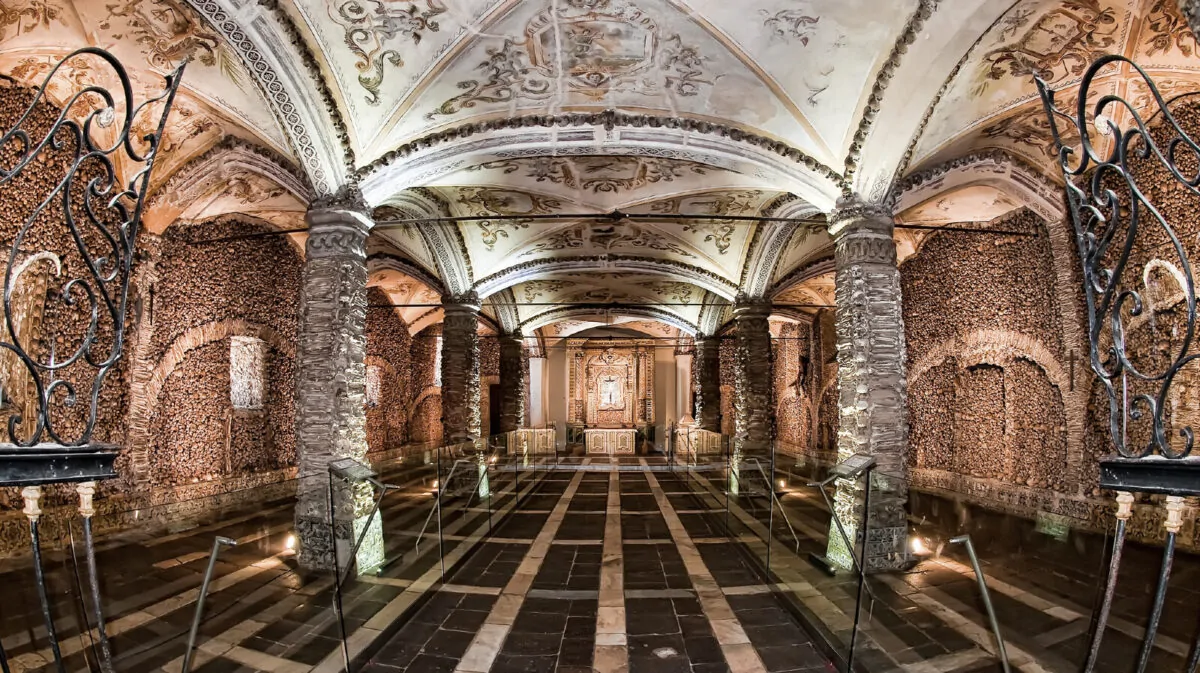
Over the next three years, he disassembled the pyramids and rebuilt them into something no one had commissioned before. He strung garlands of skulls across the vaulted ceiling. He constructed monstrances and chalices from pelvic bones and vertebrae. He assembled a chandelier containing at least one of every bone in the human body and hung it from the center of the nave. He fashioned the Schwarzenberg coat of arms in skeletal detail, complete with a raven pecking the eye socket of a skull representing a Turkish soldier — a reference to the family's 1598 conquest of the Ottoman-held fortress of Raab. When he was finished, he spelled out his own name and hometown on the wall near the entrance. The medium, of course, was bone.
Sedlec Ossuary exists because medieval Central Europe had a problem it could not solve: too many dead, not enough consecrated ground. The chapel is a monument to how societies process mass death — first through faith, when a handful of holy soil turned an ordinary cemetery into the most sought-after burial plot on the continent; then through pragmatism, when the graves were dug up and the remains stacked underground to make room for fresh corpses; and finally through aesthetics, when an artisan transformed the residue of catastrophe into devotional display. The line between veneration and spectacle has always been paper-thin here. It still is.
The Holy Soil That Made Sedlec the Most Desired Cemetery in Europe
Abbot Henry's 1278 Pilgrimage to Golgotha
The Sedlec Abbey was the first Cistercian monastery in Bohemia, founded in 1142 by monks from the Waldsassen Abbey in Bavaria. For more than a century, its cemetery was unremarkable — a regional burial ground attached to a monastic complex in a quiet corner of Central Bohemia. That changed in 1278, when King Ottokar II sent Abbot Henry of the Sedlec monastery on a diplomatic mission to the Holy Land.
Henry returned carrying a small quantity of earth he had collected from Golgotha — the hill outside Jerusalem where, according to Christian tradition, Christ was crucified. He scattered this soil across the abbey cemetery. The gesture was symbolic, but its consequences were not. Word spread across Bohemia, Moravia, Poland, and beyond that the Sedlec cemetery now contained consecrated ground from the holiest site in Christendom. To be buried in soil that had touched Golgotha was, for medieval Christians, to secure a faster path to resurrection.
The cemetery's prestige skyrocketed. Wealthy families across Central Europe began requesting burial in Sedlec. Dying pilgrims made the journey specifically to ensure their bodies would rest in the holy ground. The monastery, already economically sustained by nearby silver deposits discovered in 1260, now held something more valuable than ore — it held the promise of salvation.
The Black Death of 1348 and the 30,000 New Graves
The first mass influx of dead came in 1318, when famine struck Kutná Hora. The town, which had grown into the second most important settlement in the Kingdom of Bohemia on the back of silver mining, lost an estimated 20,000 inhabitants. All of them were buried in the Sedlec cemetery, which expanded rapidly to accommodate the dead.
Thirty years later, the Black Death arrived. The bubonic plague swept through Bohemia in 1348 and the years that followed, killing roughly 30,000 more people in the Kutná Hora region alone. The cemetery, already strained from the famine burials, ballooned to 3.5 hectares — a vast field of graves radiating outward from the monastery walls. Every available meter of consecrated earth was used. Graves were stacked. Bodies were placed atop older remains. The soil that Abbot Henry had blessed seventy years earlier was now saturated with the dead of two catastrophes.
By the end of the fourteenth century, there was simply no more room. Around 1400, a Gothic church was constructed in the center of the cemetery, with an upper chapel for worship and a lower chapel designed specifically as an ossuary — a repository for exhumed bones. The dead would have to be moved underground to make way for the newly dying. The logistics of medieval death management had reached their breaking point.
The Hussite Wars and the Sedlec Cemetery's Second Mass Burial
Jan Žižka's Armies and the Siege of Kutná Hora
Kutná Hora's strategic importance made it a target. By the early fifteenth century, the town's silver mines were producing a significant share of Europe's silver output, and its royal mint — housed in the Italian Court — struck the Prague groschen, the dominant currency of the Bohemian kingdom. Control of Kutná Hora meant control of the kingdom's treasury.
When the Hussite Wars erupted in 1419, the religious conflict between the reformist followers of Jan Hus and the Catholic establishment tore Bohemia apart. Kutná Hora, loyal to the Catholic crown, became a flashpoint. In 1421, Hussite forces under the legendary one-eyed commander Jan Žižka burned the Sedlec Abbey to the ground and captured the town. Thousands died in the fighting and its aftermath — soldiers, civilians, monks. Parts of the German-speaking mining population were expelled. Two large fires devastated what the armies had not already destroyed.
The cemetery at Sedlec absorbed yet another wave of the dead. An estimated 10,000 additional bodies were buried there during and after the Hussite conflict. Many of those interred bore visible injuries — fractured skulls, shattered cheekbones, wounds consistent with the maces, flails, and war wagons that defined Hussite warfare. These injuries are still visible today on skulls displayed in the ossuary, offering a forensic record of fifteenth-century combat preserved in calcium and collagen.
The Half-Blind Monk Who Stacked Sedlec's First Bone Pyramids
By the early sixteenth century, the Sedlec cemetery had been absorbing the dead for more than two hundred years, and the ground could hold no more. Around 1511, according to a persistent legend that has become inseparable from the ossuary's identity, the task of exhuming the graves and transferring the skeletal remains to the lower chapel was assigned to a single half-blind Cistercian monk.
The scope of the work was staggering. The monk — whose name has not survived — spent years pulling bones from the soil, carrying them underground, and stacking them into six massive pyramids inside the crypt. He sorted them by type: skulls in one layer, femurs in the next, tibias below. The arrangement was practical, not artistic. It was a storage solution for tens of thousands of human remains that had nowhere else to go. The pyramids rose from floor to ceiling, filling the four corners of the chapel and spilling into the central space. For the next 350 years, this is how the dead of Sedlec would remain — anonymous, ordered by bone type, stacked in the dark.
František Rint and the Bone Church Decorations
The Schwarzenberg Commission and the Sedlec Bone Chandelier
Between 1703 and 1710, the architect Jan Santini Aichel redesigned the chapel in the Czech Baroque style, constructing a new entrance to stabilize the building's leaning front wall. Santini incorporated the bone decorations into his design philosophy, treating the skeletal material as an expression of Baroque piety — death brought into divine order, the bones of the faithful waiting in hope for resurrection. His original arrangements used primarily skulls and limb bones, placed in symmetrical patterns that reflected the era's fascination with the boundary between the mortal and the sacred.
The monastery was dissolved during the reforms of Emperor Joseph II in the late eighteenth century, and the property eventually passed to the House of Schwarzenberg, one of the most powerful aristocratic families in Bohemia. Sometime in the mid-1860s, the family commissioned Rint to bring a new level of order — and ambition — to the bone arrangements. What Rint delivered between 1867 and 1870 shattered Santini's spiritual framework and replaced it with something far more dramatic.
The chandelier is the centerpiece. Hanging from the center of the nave, it incorporates at least one specimen of every bone in the human body — all 206 of them — woven into a structure that drips with garlands of vertebrae and strings of jawbones. Skulls serve as candleholders. The overall effect is closer to a Gothic fever dream than to a devotional object, and it reflects the Romantic-era sensibility that Rint brought to what had been a strictly spiritual space. Where Santini had framed death as a passage to God's judgment, Rint made death the dominant visual vocabulary of the entire room.
The Schwarzenberg Coat of Arms and the Bone Signature
The most technically complex of Rint's creations is the Schwarzenberg coat of arms, a heraldic display assembled entirely from human remains. The design reproduces the family's official insignia in bone: four quartered fields, each containing symbolic elements rendered in skulls, pelvic bones, sacral bones, and vertebrae. A rounded crown sits atop the composition, its band made of sacral bones, its body shaped from pelvic bones with skulls in the centers, and a cross of long bones at its apex. The entire crown is outlined in the rounded ball joints of femur heads and fringed with rib bones.
The most arresting element sits in the lower right quarter. A raven — shaped from small bones and wire — pecks at the eye socket of a human skull. The skull is fitted with a bone "ponytail" representing the typical Turkish hairstyle of the sixteenth century. The scene commemorates Adolf zu Schwarzenberg's conquest of the Ottoman-held fortress of Győr — also known as Raab, meaning "raven" in German — in 1598. It is a family war trophy, executed in the medium of anonymous medieval dead.
Whether the coat of arms was specifically requested by the Schwarzenberg family or created by Rint as a gesture of gratitude to his patrons is unknown. What is documented is his signature: a composition of bones on the wall near the chapel entrance that spells out his name and his birthplace of Česká Skalice. Almost nothing else is known about Rint. He left no journals, no correspondence, no records of his working process. The bones are his only autobiography.
Inside the Sedlec Ossuary: The Bone Pyramids, Skull Garlands, and Chandelier
The Bone Pyramids and Skull Garlands of the Lower Chapel
The chapel is small — roughly the footprint of a modest parish church — and the descent into it takes only a few steps. Visitors enter through Santini's Baroque entrance and walk down a stone staircase into a space that is both dimmer and more densely decorated than any photograph can convey. The air is cool and faintly mineral, the temperature held steady by the surrounding earth and limestone.
Four massive bell-shaped mounds of bones occupy the corners of the lower chapel, each rising several meters from the floor toward the vaulted ceiling. These are the reconstructed descendants of the half-blind monk's original pyramids, rebuilt and refined by Rint in the nineteenth century and restored again during the ongoing conservation project that began in 2014. Each pyramid contains thousands of skulls and long bones stacked in alternating layers, the skulls facing outward, their empty eye sockets forming a wall of hollow gazes. Above them, suspended from the vault, wooden crowns symbolize the gateway to the heavenly kingdom — a remnant of Santini's theological interpretation that Rint chose to preserve.
Garlands of skulls and vertebrae drape across the ceiling between the pyramids, connecting the four corners of the chapel in sweeping arcs. Bone monstrances — the liturgical vessels used in Catholic churches to display the consecrated host — flank the altar, their shafts and bases assembled from femurs and hip bones. Everywhere, the architecture of the human body has been repurposed into the architecture of the sacred space. The effect is disorienting: the eye cannot distinguish where the building ends and the bones begin.
Some skulls bear visible evidence of their owners' deaths. Fractured craniums, caved-in cheekbones, and puncture wounds consistent with medieval weapons are plainly visible on bones in the pyramids and garlands — a forensic map of the Hussite Wars that killed many of these people six centuries ago. Visitors who look closely will also notice the size variation: adult skulls beside child-sized ones, the famine and plague of the fourteenth century having been indiscriminate in their selection.
Jan Švankmajer's Banned Ossuary Film and Communist-Era Censorship
In 1970, exactly one century after Rint completed his work, Czech filmmaker Jan Švankmajer — who would later become one of the most influential surrealist animators in European cinema — was commissioned to document the ossuary. The result was a ten-minute film of frantic-cut skeletal imagery set to the monotone narration of an actual tour guide, a juxtaposition that treated the ossuary's horror and banality as inseparable.
The Communist authorities banned the film for alleged subversion. The original soundtrack was replaced by a jazz arrangement of a Jacques Prévert poem, and the film circulated only in this sanitized form until the Velvet Revolution of 1989 restored the original version. Švankmajer's film remains one of the most striking artistic responses to the ossuary — a reminder that the bones have never been politically neutral, and that a place dedicated to the permanence of death can still threaten the living.
The Sedlec Ossuary Restoration: 1,200 New Skeletons Discovered
The 2014 Conservation Project and the Discovery of 1,200 New Skeletons
The ossuary had been deteriorating for decades. Extreme humidity in the lower chapel was damaging the skeletal decorations, the masonry, and Santini's original stucco work. The building itself had shifted nearly half a meter from its vertical axis. In 2014, the Roman Catholic parish of Kutná Hora–Sedlec launched a comprehensive restoration project, serving as the sole investor. By 2023, over 107 million Czech crowns — roughly 4.5 million euros — had been spent.
The restoration process is as methodical as Rint's original work was improvisational. Conservation expert Tomáš Král and his team dismantled the bone pyramids section by section, cleaned each bone of surface dirt, soaked them in lime solution — the same preservation method used when the pyramids were first assembled — and then restacked them according to Rint's original arrangement, verified through photographic records and computer models produced by the firm Naše Historie using videomapping technology. Gothic keystones and stone ribs were discovered hidden within the Baroque brick vault during plaster removal in 2024, confirming the presence of the original Gothic structure beneath Santini's eighteenth-century renovation.
The excavations also yielded a discovery no one had anticipated. Archaeologists working around the ossuary's foundation uncovered 34 previously unknown mass graves containing approximately 1,200 additional skeletons — the largest find of its kind in the Czech Republic. The remains showed a significant prevalence of men over women, consistent with what archaeologist Jan Frolík described as a mining population. The equal ratio of adults to children matched the expected demographic profile of a medieval town, but the gender imbalance pointed to the dangerous, male-dominated work in Kutná Hora's silver mines. The dead had been there all along, directly beneath the chapel's floor, unknown to the half-blind monk, to Santini, to Rint, and to the half-million tourists who had walked above them every year.
Bone Church Tourism: Photography Ban and the Ethics of Visiting
The Sedlec Ossuary draws over 200,000 visitors annually — though some pre-pandemic estimates placed the figure closer to 500,000 — making it one of the most visited tourist attractions in the Czech Republic. The chapel is part of the broader Kutná Hora UNESCO World Heritage Site, designated in 1995 for its outstanding medieval architecture, which also includes the Sedlec Cathedral and the Gothic Cathedral of St. Barbara.
Photography inside the ossuary has been banned. The decision reflects an ongoing tension that has defined the site for decades: the bones are simultaneously a tourist attraction and a functioning burial site. Radka Krejčí, the director of the Sedlec parish, has been direct about the problem. The ossuary is not a haunted house or a dark spectacle. It is a place of reverence — a cemetery where the dead were once placed in the hope of resurrection, and where their remains continue to serve a sacred function even in their most theatrical arrangement.
The tension is irresolvable, and the ossuary does not pretend otherwise. Rint's decorations are undeniably artistic, deliberately dramatic, and designed to provoke a visceral response. The Paris Catacombs — the world's largest ossuary, holding the relocated remains of roughly six million Parisians — addressed a similar logistical crisis in the eighteenth century, but with a more restrained aesthetic: bones arranged in neat walls, anonymous and uniform. Rint went the opposite direction. He made individual bones into spectacle, and in doing so, he ensured that the dead of Sedlec would never be forgotten — even if they could never be identified.
Visiting the Sedlec Bone Church: Hours, Tickets, and What to Expect
The ossuary sits in Sedlec, a suburb of Kutná Hora, approximately 70 kilometers east of Prague. The most practical route is a 55-minute train from Prague's main station to Kutná Hora, with regular daily service. From the Kutná Hora train station, the ossuary is roughly a ten-minute walk. The Chapel of All Saints is an unassuming Baroque structure from the outside — visitors unfamiliar with its interior could easily walk past it without a second glance.
Admission is ticketed, and advance online booking with a specific date and time is strongly recommended — capacity inside the lower chapel is limited, and peak-season slots sell out quickly. The maximum visit duration for the lower chapel is 30 minutes. The upper chapel has no time restriction. Photography is prohibited in the lower chapel. Guided tours can be arranged in advance for groups, but individual visits are self-guided, with informational leaflets available inside.
The ossuary should be paired with a visit to the adjacent Sedlec Cathedral (the Cathedral of the Assumption of Our Lady and Saint John the Baptist), a Baroque Gothic masterpiece also designed by Santini Aichel and part of the same Cistercian complex. Both are UNESCO-listed. The Cathedral of St. Barbara in Kutná Hora's historical center — a Gothic landmark whose construction spanned more than five hundred years — is equally essential, along with the Italian Court, the medieval royal mint where Prague groschen were once struck. The Czech Museum of Silver offers tours of an authentic medieval mine shaft beneath the town, accessible via a 33-meter staircase built into an original air shaft.
Standing in the ossuary is unlike standing at any other site of mass death. There is no memorial wall, no list of names, no narrative explaining who these people were. The 40,000 to 70,000 individuals whose remains fill this room died of plague, famine, and war over a span of two centuries, and not one of them can be identified. What remains is not their story but their material — calcium and phosphate, arranged into shapes that a woodcarver from a small Czech town decided were beautiful. The question the ossuary asks is not whether Rint was right to do what he did. It is whether there is any way to honor the anonymous dead that does not, in some measure, also use them.
FAQ
What is the Sedlec Ossuary?
The Sedlec Ossuary is a Roman Catholic chapel located beneath the Cemetery Church of All Saints in Sedlec, a suburb of Kutná Hora in the Czech Republic. Its interior is decorated with the skeletal remains of an estimated 40,000 to 70,000 people who died during the Black Death, a famine in 1318, and the Hussite Wars of the early fifteenth century. The decorations — including a chandelier, garlands of skulls, and a heraldic coat of arms — were created by woodcarver František Rint between 1867 and 1870. The ossuary is part of the Kutná Hora UNESCO World Heritage Site and draws over 200,000 visitors annually.
Why are there so many bones in the Sedlec Ossuary?
The cemetery surrounding the chapel became one of the most desirable burial sites in Central Europe after Abbot Henry brought a handful of earth from Golgotha in Jerusalem in 1278 and scattered it over the grounds. People across Bohemia, Moravia, and Poland requested burial in the holy soil. A famine in 1318 killed approximately 20,000 people in the Kutná Hora region, and the Black Death of 1348 added roughly 30,000 more. The Hussite Wars in the early fifteenth century contributed another estimated 10,000 dead. When the cemetery ran out of space, older graves were exhumed and the bones were transferred to the lower chapel of a Gothic church built around 1400.
Who decorated the Sedlec Ossuary with bones?
The current bone decorations are primarily the work of František Rint, a woodcarver from Česká Skalice, who was commissioned by the Schwarzenberg family between 1867 and 1870. Rint created the famous chandelier, the garlands of skulls, the Schwarzenberg coat of arms, and various other skeletal arrangements. An earlier decorative scheme was designed by Baroque architect Jan Santini Aichel during renovations between 1703 and 1710. Before either artist, a half-blind Cistercian monk is said to have first exhumed and stacked the bones into pyramids around 1511.
Can you take photos inside the Sedlec Ossuary?
Photography inside the lower chapel of the ossuary is prohibited. The ban reflects the site's status as a functioning sacred space and burial site, not merely a tourist attraction. The parish has emphasized that the ossuary is a place of reverence and contemplation, and the photography restriction is intended to preserve that atmosphere. Visitors are encouraged to experience the chapel directly rather than through a camera lens.
How do I get to the Sedlec Ossuary from Prague?
The most convenient route is by train from Prague's main station to Kutná Hora, a journey of approximately 55 minutes with regular daily service. From the Kutná Hora train station, the ossuary is about a ten-minute walk. Advance online ticket purchase with a specific date and time slot is strongly recommended, as the chapel has limited capacity and popular time slots sell out quickly. The maximum visit duration in the lower chapel is 30 minutes.
Is the Sedlec Ossuary still being restored?
A major restoration project has been underway since 2014, funded by the Roman Catholic parish of Kutná Hora–Sedlec. By 2023, over 107 million Czech crowns had been invested. The work has included dismantling and cleaning the bone pyramids, restoring Santini's original Baroque stucco decorations, and stabilizing the building's structure. During excavations, archaeologists discovered 34 previously unknown mass graves containing approximately 1,200 additional skeletons. The ossuary has remained open to visitors throughout the restoration, though some areas may be temporarily restricted. A new exhibition in the lower chapel is planned to open in April 2027.
Sources
- Ossuary History - Sedlec.info / Roman Catholic Parish of Kutná Hora–Sedlec (2024)
- Ossuary Repair: Restoration Progress Reports 2014–2024 - Sedlec.info / Roman Catholic Parish of Kutná Hora–Sedlec (2024)
- Coat of Bones: The Schwarzenberg Coat of Arms - The Sedlec Ossuary Project, Medium (2019)
- Czechs Clean Thousands of Human Bones in Ossuary Renovation - Jan Lopatka, Reuters (2019)
- Czech 'Bone Church' at Sedlec Ossuary Continues Years-Long Restoration - Expats.cz (2019)
- Over 1,000 Skeletons Discovered During the Renovation of 'Bone Church' - The Vintage News (2020)
- Visit the Creepy Bone Church of Czech Republic - Cassandra Bednarz, National Geographic Travel (2021)
- Kutná Hora's Italian Courtyard and Silver-Mining History - Radio Prague International (2021)
- Kutná Hora: Historical Centre with the Church of St. Barbara and the Cathedral at Sedlec - UNESCO World Heritage Centre (1995)
- Sedlec Ossuary "Bone Church" - Atlas Obscura (2013, updated)
- Kostnice Sedlec (Sedlec Ossuary): František Rint - SPACES Archives (2016)