The Night Crawfish Rock Celebrated and Próspera Filed Suit
Venessa Cárdenas stayed up past two in the morning on the night of April 21, 2022, texting and calling friends and family. Luisa Connor, president of the Crawfish Rock community council, said she could finally "sleep freely." The Honduran Congress had just voted unanimously — 128 to zero — to repeal the ZEDE law, the legislation that had allowed a private company to build a semi-autonomous city on the doorstep of their village. President Xiomara Castro declared that Honduras was "recovering its sovereignty."
On the other side of the chain-link fence, past the security booth and the surveillance cameras, the celebration was not shared. Honduras Próspera Inc. announced a new $60 million investment round and adopted Bitcoin as legal tender within its zone. Construction continued as though nothing had happened. Eight months later, the company filed a claim with the International Centre for Settlement of Investment Disputes (ICSID) — a World Bank tribunal — demanding $10.7 billion in damages. The figure represented not what Próspera had lost, but what it claimed it would have earned over a 30-year business plan that had barely begun.
The claim distilled a question that will define governance disputes for the rest of the century: can a democratically elected government repeal its own laws, or does a foreign corporation's projection of future profit override the will of an entire nation's electorate? Próspera was not a mine, a factory, or an oil concession — the usual subjects of investor-state arbitration. It was a private city-state, a jurisdiction within a jurisdiction, conceived by Silicon Valley libertarians and incubated under a regime that the United States would later prosecute for running a narco-state. The people of Crawfish Rock, the Afro-descendant fishing community that had lived on Roatán's north coast for generations before any investor arrived, never voted for it, were never consulted about it, and learned its true nature only after construction had already begun.
The 2009 Coup and the Law That Opened Honduras to Private Cities
The morning of June 28, 2009, approximately one hundred soldiers stormed the presidential residence in Tegucigalpa, detained President Manuel Zelaya at gunpoint, and flew him to Costa Rica in his pajamas. Zelaya had drifted leftward — raising the minimum wage, subsidizing small farmers, joining Venezuela's Bolivarian oil alliance — and his proposal for a non-binding constitutional referendum had infuriated the military, the judiciary, and the country's business oligarchy. The United Nations, the Organization of American States, and the European Union condemned the removal as a coup. The OAS voted unanimously to suspend Honduras. The Obama administration initially called it "clearly illegal," then quietly moved to legitimize the elections that followed.
The coup's most consequential beneficiary was Juan Orlando Hernández, a National Party congressman who became president of the Honduran Congress in January 2010. Hernández rose through a post-coup political landscape in which institutional guardrails had been shattered. In December 2012, in what critics called a "technical coup" against the judiciary, the Congress he presided over dismissed four Supreme Court magistrates from the Constitutional Chamber — the same judges who had ruled an earlier version of the charter-city concept unconstitutional. A revised law was drafted. The reconstituted Supreme Court approved it in 2014.
Hernández became president in 2014 and won a constitutionally dubious reelection in 2017 — a result the OAS described as an "extreme statistical improbability." Throughout his tenure, the United States treated him as a key ally, channeling millions in security assistance. In April 2022, on the same day Honduras voted to repeal the ZEDE law, Hernández was extradited to New York to face drug trafficking charges. A U.S. court sentenced him to 45 years in prison for conspiring to import cocaine. In December 2025, Donald Trump pardoned him.
Paul Romer's Charter Cities and the Honduran Mutation
The intellectual origin of the ZEDE was respectable. Paul Romer, the Nobel Prize–winning economist, proposed "charter cities" as autonomous zones within developing countries, governed by transparent third-party guarantors — a trusted foreign government, for example — to attract investment and build institutional credibility. The idea was that good governance could be imported where it did not yet exist.
Honduras was supposed to be Romer's proof of concept. He served as chair of a transparency commission overseeing the project's early development. The arrangement lasted less than a year. In September 2012, Romer resigned publicly, citing a total lack of transparency. The Honduran government, he said, had signed agreements with international developers without informing him — the person charged with ensuring oversight. The concept he had designed to demonstrate accountable governance had been captured by actors who wanted no accountability at all.
Romer's exit was a warning. The door he opened did not close behind him.
The ZEDE Framework — A Private City with Its Own Courts and Police
The legislation that emerged from the post-coup political machinery went far beyond any Special Economic Zone in modern history. The ZEDE law — Zones for Employment and Economic Development — authorized private investors to create semi-autonomous jurisdictions with their own legal systems, tax codes, courts, police forces, and regulatory frameworks. The zones operated under a 50-year legal stability guarantee, meaning the Honduran government committed to not altering the rules for half a century. A governing council with corporate veto power oversaw each zone. An unelected Committee of Best Practices, appointed by the government, was supposed to provide oversight — but the committee's practical authority was limited.
The law also included Article 28, which granted ZEDEs powers of eminent domain — the ability to expropriate private land within their designated territory. For the residents of Roatán's coastal communities, this provision would become the source of their deepest fear: that the private city next door could, under Honduran law, legally take their land.
Erick Brimen and the Founding of Próspera on Roatán
Erick Brimen grew up in Venezuela, watching what he later described as the "poverty caused by socialism and lack of rule of law." He moved to the United States, studied at Babson College, and built a career in finance — private banking at Brown Brothers Harriman, mergers and acquisitions at AG Edwards, consulting for private equity clients at Ernst & Young in London, then CFO of a Latin American conglomerate. In 2013, he founded NeWay Capital, a firm dedicated to creating free-market zones in developing countries. By 2017, he had submitted a formal application for a charter city in Honduras.
Brimen bought land on Roatán's north coast through a network of intermediate companies — Brimont Holding, North Shore Development Company — and secured approval for his ZEDE charter in late 2017. The venture attracted heavyweight investors: Peter Thiel and Marc Andreessen backed it through the venture capital firm Pronomos Capital. Balaji Srinivasan, the tech entrepreneur and "network state" theorist, invested. In January 2025, Coinbase's venture division joined the roster. Brimen described Próspera as a "poverty relief initiative." The residents of the village next door experienced it differently.
Crawfish Rock — The Village Next Door
Crawfish Rock is a coastal settlement of roughly 600 people on Roatán's north coast, predominantly English-speaking Afro-descendants whose ancestors were brought to the Bay Islands by the British in the 18th and 19th centuries. The village was named for the lobsters — called crawfish locally — that once filled its waters in such abundance that they defined the community's identity. Residents fish, farm, catch crab, and build houses. The settlement sits beside mangrove forests that serve as nurseries for snappers, bonefish, and shrimp, adjacent to the Bay Islands National Marine Park.
Investors first appeared in Crawfish Rock around 2016, presenting themselves as a charitable foundation. They opened a community center and discussed plans for a tourist development nearby. Residents had no reason to be suspicious — Roatán is one of the Caribbean's top tourist destinations, and foreign-owned resorts and vacation homes line the coast. "It's not anything out of the way for people to come and start building around us or starting projects," Connor later told journalists.
The truth arrived in mid-2020. Community leaders discovered that the project next door was not a resort. It was a private city with its own laws, its own police, and — under Article 28 of the ZEDE law — the theoretical power to expropriate their land. A drawing of Próspera's later development phases, published on the project's website, included parts of Crawfish Rock within the zone's planned boundaries. Connor, the community council president, had been leading opposition to Próspera ever since. "It's not fair what we are facing in Crawfish Rock," she said in 2023, "because it's not something we sought out — they sought us out."
The Water That Stopped Flowing
The most documented point of conflict between Próspera and Crawfish Rock was water. In the summer of 2019, the village lost access to its running water supply. Próspera connected Crawfish Rock to its own water tank — a gesture the company framed as goodwill. The presidenta of the Patronato, the village's community organization, described what happened next: Próspera began charging fees. "They said it would improve the system," she told a visiting researcher, "but it was a way to control us."
During the COVID-19 crisis, Próspera suspended the fees. When the company learned that villagers were attempting to restore their old, independent water system, it turned off the taps entirely. The message was not subtle. Development funds that Próspera had earmarked for Honduran communities never reached Crawfish Rock. The village's roads remained unpaved. Sewage problems persisted. The private city next door, meanwhile, had imported its own electricity, its own security infrastructure, and its own legal system — all while using Roatán's public garbage dump, airport, and roads.
Inside the ZEDE — How Próspera Actually Works
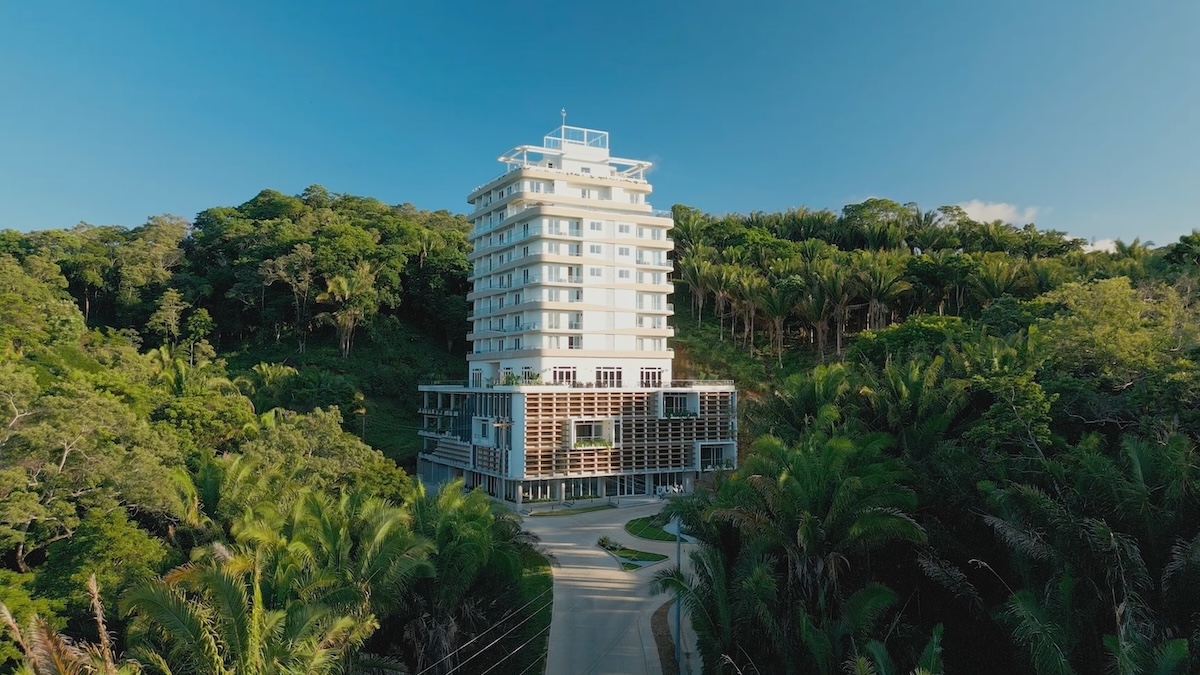
Próspera occupies a small footprint on Roatán's north coast, anchored by the Duna Residences — a fourteen-story tower of treated glass and sustainable timber designed by Patrik Schumacher, a partner at Zaha Hadid Architects. The master plan envisions modular housing units, robotic micro-manufacturing facilities, and a "Governance as a Service" platform that treats laws as products and taxes as subscription fees. Bitcoin is legal tender within the zone. Entry requires passing through a gate staffed by armed guards.
The zone is governed by a nine-member council: five elected members and four appointed by Honduras Próspera Inc. Decisions require a two-thirds majority, which gives the corporation an effective veto over any governance decision. Above the council sits the Committee of Best Practices, an unelected body whose members are appointed by the Honduran government. In practice, the architecture of governance concentrates decision-making power in the hands of the company that built the city.
Governance as a Service and the Agreement of Coexistence
Anyone entering Próspera signs an "Agreement of Coexistence" — a document that functions less like a social contract than like a software license. Signatories agree to submit disputes to private arbitration rather than public courts. They become "e-residents," a category that carries privileges rather than rights — privileges that can be revoked for violating the zone's terms. The regulatory system offers what Próspera calls "regulatory election": companies operating within the zone can choose which OECD country's regulatory framework applies to their business, mixing and matching rules from different nations as if selecting options from a menu.
Longevity Clinics and Crypto Summits on a Honduran Island
The economic activity within Próspera has gravitated toward niches that thrive in low-regulation environments. Minicircle, a biotech startup backed by Sam Altman and Thiel, offers a reversible gene therapy treatment available only within the zone. In 2024, anti-aging entrepreneur Bryan Johnson traveled to Próspera to undergo the treatment, documenting the visit on his YouTube channel. A biotech conference held in the zone that year operated under the theme "Make death optional" and generated $1.5 million in venture capital investment. Próspera hosted a "crypto cities summit" in February 2025. Under its financial model, 88 percent of the zone's revenue stays within the city, with the remainder placed in a trust nominally intended for Honduran development.
These activities unfold on an island in a country where 60.1 percent of households live below the national poverty line and one in four children under five suffers from chronic malnutrition. The dissonance is not metaphorical. It is geographical — measurable in the 200 meters between the Duna Tower and the unpaved roads of Crawfish Rock.
The $10.7 Billion Lawsuit Against Honduras
When the Honduran Congress repealed the ZEDE law in April 2022, Próspera's founders did not negotiate, convert to a different legal framework, or accept the democratic verdict. In December 2022, Honduras Próspera Inc. — along with St. John's Bay Development Company and Próspera Arbitration Center, both incorporated in the United States — filed an investor-state arbitration claim under the Dominican Republic-Central America Free Trade Agreement (CAFTA-DR). The venue was ICSID, the World Bank's arbitration body, which adjudicates disputes between foreign investors and sovereign states.
The legal arguments rested on three pillars: expropriation (the repeal destroyed the investment), breach of the minimum standard of treatment guaranteed under CAFTA-DR, and violation of the 50-year legal stability guarantee embedded in the ZEDE framework. In February 2025, the ICSID tribunal rejected Honduras's preliminary objection — an argument that the investors should have exhausted Honduran courts before filing internationally — and allowed the case to proceed. By October 2025, Próspera's damages experts at the Berkeley Research Group had revised the claim upward: the "intrinsic value" of the company's 30-year business plan was, they argued, $10.6 billion on average, and potentially as high as $26.4 billion.
Honduras responded by withdrawing from ICSID entirely in August 2024. The withdrawal prevents future cases from being filed but does not affect pending claims. A flurry of additional investor-state cases were filed against Honduras just before the withdrawal took effect — fifteen active cases demanding at least $14 billion in total.
A Claim Worth Two-Thirds of a Nation's Budget
The scale of Próspera's claim becomes legible only when measured against the country it targets. Honduras's annual government budget is approximately $17 billion. The $10.7 billion demand is equivalent to roughly 60 percent of that figure. It is a sum that could fund the country's entire public health system for years. It is being claimed by a company that had invested approximately $150 million — a return-on-investment demand of more than 70 to 1, not on realized profits, but on projected future earnings from a city that had barely broken ground.
Eighty-five leading economists from around the world signed a letter praising Castro's decision to repeal the ZEDE law and criticizing the ICSID system, noting "scant economic evidence that mechanisms like ICSID stimulate meaningful foreign direct investment." At the United Nations General Assembly, Castro called ZEDE land "irrigated with the blood of native peoples." The dispute was no longer about one city on one island. It had become a test case for whether investor-state arbitration — a system designed to protect foreign capital — could effectively override democratic governance. The parallel to other imposed jurisdictions is direct: like Guantánamo Bay, Próspera operates as a legal territory grafted onto a sovereign nation's soil, functioning under rules the host country's citizens did not choose and cannot easily change.
The Backers and the Lobbyists
Próspera's investor roster reads like a directory of Silicon Valley's libertarian wing. Thiel and Andreessen backed the project through Pronomos Capital. Coinbase CEO Brian Armstrong announced his company's investment in January 2025, framing it as a commitment to "financial inclusion and innovation." Brimen himself spent hundreds of thousands of dollars lobbying U.S. legislators to pressure Honduras — advocating for sanctions, aid cuts, and visa restrictions against Honduran government officials if the country refused to allow Próspera to continue operating.
The lobbying bore fruit. U.S. Representative Steven Horsford — who received a $5,000 campaign donation from Brimen in 2023 — pressured Honduras by advocating for visa denials targeting government officials. Representative María Elvira Salazar publicly attacked the ZEDE repeal, declaring that "socialists once again show that they are more interested in their own power and ideology than in the prosperity of their country." Provisions in the 2024 U.S. House budget attempted to condition aid on Honduras allowing ZEDEs to continue as designed. The U.S. embassy in Tegucigalpa publicly criticized Honduras for discouraging investment.
The pattern — a private company leveraging U.S. political power to override a foreign government's democratic decisions — was not new in Honduran history. It echoed the dynamics that earned Honduras its original reputation as a "banana republic," a country whose sovereignty has been repeatedly subordinated to American corporate interests since the early 20th century. The difference was that instead of United Fruit Company, the actors were venture capitalists, and instead of bananas, the commodity was governance itself.
Próspera Today — The Private City That Won't Leave
As of early 2026, Próspera remains operational. Construction continues on Roatán. The ICSID arbitration is pending, with no final ruling expected in the near term. The Honduran Supreme Court issued a divided 3-2 ruling declaring the ZEDEs unconstitutional with retroactive effect, but Próspera's legal team dismissed the decision as a violation of the "acquired rights" doctrine — the legal principle that changes in law cannot retroactively destroy vested interests.
The political terrain has shifted further. Hernández's December 2025 pardon by Trump removed the symbolic weight of his conviction — the former president who championed ZEDEs is no longer in prison. Brimen and his investors have signaled no intention of withdrawing. Reports indicate that the same network of Silicon Valley financiers behind Próspera — Thiel, Andreessen, and others — have turned their attention to Greenland, envisioning a libertarian tech hub with AI labs, data centers, and minimal regulatory oversight. The charter-city model is not retreating. It is expanding.
In Crawfish Rock, the fight continues. Connor has spoken at international forums, including the presentation of a report titled The Corporate Assault on Honduras. The village still lacks paved roads. The community center that Próspera's foundation originally opened has become a symbol of the bait-and-switch that residents describe — charity as a gateway to displacement. A Seacology grant is funding mangrove replanting and environmental education programs. The lobsters that gave the village its name are diminished, but the community remains.
The story of Próspera maps onto a pattern that recurs across every continent: the collision between planned utopias and the communities they displace. Fordlândia imposed an American rubber city on the Amazon without consulting the people who lived there. Forest City built four artificial islands on Malaysia's largest seagrass meadow for Chinese buyers who never arrived. Rajneeshpuram tried to build a private utopia inside a hostile jurisdiction and collapsed under the weight of its own contradictions. Each project shared the same foundational assumption: that a place could be made from scratch, freed from the friction of existing human communities. Each discovered that the friction was the point.
Visiting Próspera and Crawfish Rock
Roatán is accessible by direct flights from Houston, Miami, and several Central American cities, or by ferry from La Ceiba on the Honduran mainland. The island is one of the Caribbean's premier dive destinations, renowned for its coral reefs and warm waters. Próspera sits on the north coast, near the community of Crawfish Rock.
Entering the ZEDE requires passing through a gated checkpoint with armed security. Visitors must sign the Agreement of Coexistence. The zone itself is small — a handful of buildings, the Duna Tower, construction sites — and can feel eerily quiet relative to its ambitions. Crawfish Rock is accessible without restriction and can be visited through community-based tour operators; some tours include a traditional seafood lunch prepared by local families in their homes.
This is not a historical site. It is an active legal and political conflict. The ICSID case is pending. Construction is ongoing. The community next door is still fighting for its water, its land, and its right to exist on its own terms. Visitors should understand that their presence carries weight — this is a place where the question of who belongs, who decides, and who profits has not been resolved. The armed guard at the gate and the unpaved road on the other side of the fence tell the same story from two directions.
FAQ Section
What is Próspera in Honduras?
Próspera is a semi-autonomous charter city on the island of Roatán, Honduras, operating under the ZEDE (Zone for Employment and Economic Development) framework. Established in 2017 by Venezuelan-born entrepreneur Erick Brimen and backed by investors including Peter Thiel and Marc Andreessen, it functions as a private jurisdiction with its own legal system, tax code, courts, police, and regulatory framework. The zone operates under a governance model called "Governance as a Service," where laws are treated as products and residents sign an "Agreement of Coexistence" to enter. Bitcoin is legal tender within the zone. Próspera is currently at the center of a major sovereignty dispute after Honduras repealed the ZEDE law in 2022 and the company filed an international arbitration claim in response.
Why is Próspera suing Honduras?
Honduras Próspera Inc. filed a claim with the International Centre for Settlement of Investment Disputes (ICSID) in December 2022 after the Honduran Congress voted unanimously to repeal the ZEDE law that authorized Próspera's existence. The company argues that the repeal constitutes expropriation of its investment, violates the minimum standard of treatment guaranteed under the CAFTA-DR trade agreement, and breaches a 50-year legal stability guarantee embedded in the original ZEDE legislation. The initial claim was for $10.7 billion. By October 2025, Próspera's damages experts revised the potential figure upward to as high as $26.4 billion. The ICSID tribunal rejected Honduras's preliminary objections in February 2025 and allowed the case to proceed.
How much is the Próspera ICSID lawsuit worth?
The original claim filed in December 2022 sought up to $10.7 billion in damages — roughly two-thirds of Honduras's annual national budget. By October 2025, Próspera's damages experts at the Berkeley Research Group estimated the "intrinsic value" of the company's 30-year business plan at an average of $10.6 billion, with a potential ceiling of $26.4 billion. The claim is based on projected future earnings, not realized profits. Próspera had invested approximately $150 million at the time of filing. The case is one of fifteen active investor-state claims against Honduras, totaling at least $14 billion in known demands.
What happened to the ZEDE law in Honduras?
The ZEDE law was originally passed in 2013 under the government of Juan Orlando Hernández, following a 2012 Congressional action that dismissed four Supreme Court magistrates who had ruled an earlier version of the charter-city concept unconstitutional. The reconstituted court approved the revised law in 2014. In November 2021, Xiomara Castro won the Honduran presidency on a platform that included repealing the ZEDE framework. The Congress voted 128-0 to repeal the law in April 2022. The Honduran Supreme Court subsequently issued a divided 3-2 ruling declaring ZEDEs unconstitutional with retroactive effect. Honduras withdrew from ICSID entirely in August 2024 to prevent future arbitration claims, though pending cases remain active.
What is Crawfish Rock and why does it matter to the Próspera story?
Crawfish Rock is a coastal village of approximately 600 residents on Roatán's north coast, directly adjacent to Próspera. The community is predominantly English-speaking Afro-descendants whose ancestors were brought to the Bay Islands by the British in the 18th and 19th centuries. Residents rely on fishing, farming, and crab catching for their livelihoods. The village was not consulted about the creation of Próspera and did not learn the project's full scope until mid-2020, after construction had begun. Conflicts over water access, land rights, and the ZEDE law's eminent domain provisions have made Crawfish Rock the focal point of local opposition. Community leaders Luisa Connor and Venessa Cárdenas have led resistance efforts and spoken at international forums about the impact on their community.
Can you visit Próspera?
Próspera is physically accessible on Roatán, which receives direct flights from Houston, Miami, and several Central American cities. Entering the ZEDE requires passing through a gated security checkpoint and signing the Agreement of Coexistence. The zone itself is small — a handful of buildings and active construction sites. Crawfish Rock, the neighboring village, can be visited without restriction, and some community-based tour operators offer visits that include traditional home-cooked meals. Visitors should be aware that this is an active legal and political conflict, not a historical site. The ICSID arbitration is pending, construction continues, and the community's fight over water, land, and sovereignty remains unresolved.
Sources
- [A libertarian 'startup city' in Honduras faces its biggest hurdle: the locals] - Ian MacDougall, Isabelle Simpson, and Daniele Volpe / Rest of World (2021)
- [Crypto-libertarian paradise, Próspera, just lost its battle with Honduras] - Rest of World (2022)
- ['Go home': Honduran islanders fight against crypto colonialists] - Jeff Ernst / The Guardian (2022)
- [Crypto Bros Are Trying to Bankrupt Honduras for Scuttling Their Private Cities] - Foreign Policy in Focus (2025)
- [Charter cities in Roatan, Honduras] - Sharon Gal-Or / Ocean Nexus, University of Washington (2025)
- [Honduras Fights Back Against Global Oligarchy] - Public Seminar, The New School for Social Research (2025)
- [A Local Remedies Pitfall Avoided—for Now: Key Takeaways from Honduras Próspera Inc. v. Honduras] - Kluwer Arbitration Blog (2025)
- [Honduras Próspera Inc. v. Republic of Honduras, ICSID Case No. ARB/23/2 — Decision on Preliminary Objections] - ICSID / World Bank (2025)
- [World Report 2026: Honduras] - Human Rights Watch (2026)
- [From Honduras to Greenland: Inside the Billionaire Blueprint for Deregulated Cities] - 21st Century Wire (2026)
- [The rise and fall of loyal US client Juan Orlando Hernández] - Responsible Statecraft (2024)
- [Roatán Relief — Crawfish Rock Community Center] - Bay Islands Conservation Association (BICA)


.jpeg)