Arriving in Naples: The Spanish Quarter and the Invisible Borders of the Camorra
Stepping out of the Napoli Centrale station into the crushing humidity of Piazza Garibaldi is an act of total sensory immersion. The air carries weight — sulfur from the dormant Phlegraean Fields, exhaust from ten thousand untamed scooters, the yeasty perfume of frying dough, and the sharp tang of uncollected refuse baking in the sun. In the Quartieri Spagnoli, the Spanish Quarter, the buildings press so close together that direct sunlight reaches the street for roughly an hour a day. Laundry hangs across every gap. A Honda SH300 scooter — the preferred vehicle of the scippatori, the snatch-and-grab thieves — screams off 17th-century stucco like a gunshot.
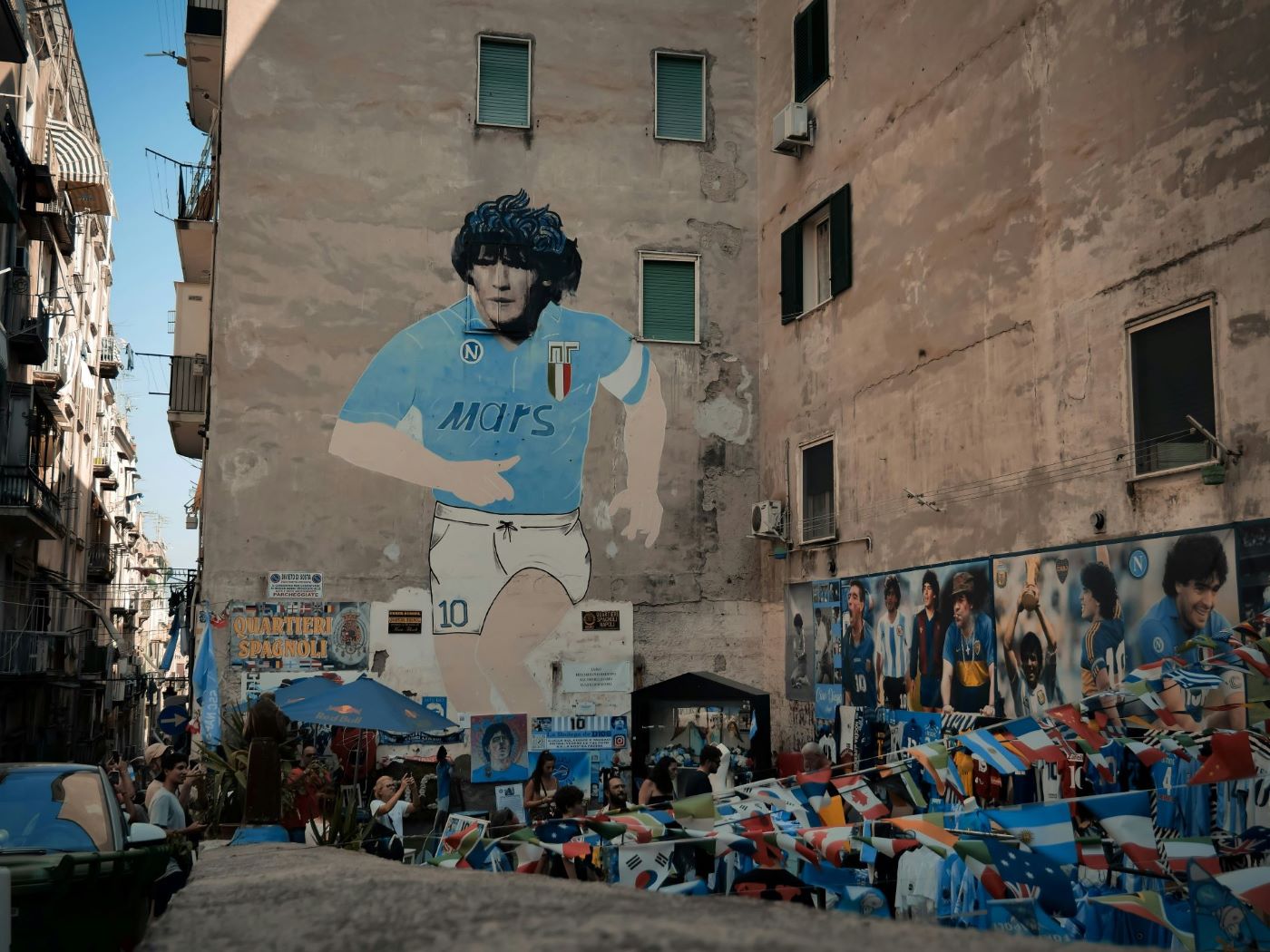
Beneath the noise, a different kind of attention operates. A visitor walking through the Quarter is watched — not necessarily with malice, but with a territorial awareness that predates the Italian Republic. A shrine to Diego Maradona, the city's secular deity, glows with blue votive candles; ten feet away, a smaller, darker shrine commemorates a fallen soldier of the local clan. The sacred and the profane are not neighbors in Naples. They are blood relatives. This is the domain of O Sistema — The System — a subterranean state that has operated in the shadow of Vesuvius for longer than most European democracies have existed.
The Camorra is not a branch of the Sicilian Mafia. The Cosa Nostra of Corleone is a pyramid — rigid, hierarchical, governed by a single boss of bosses. The Camorra is a hydra: a horizontal, chaotic federation of independent clans that mirrors the unruly urban geography of Naples itself. Neapolitans rarely use the word "Camorra." They call it O Sistema. The terminology is telling. It implies not a criminal aberration but a functional economic structure — a corporate entity that deals in logistics, waste management, textile manufacturing, and narcotics. It provides loans when banks refuse. It provides justice when the courts are too slow. It provides employment where the state has failed. From the counterfeit designer bags sold on the Via Toledo to the concrete of the high-rises in the periphery, the fingerprints of the System are everywhere. It is a parasite that has grown so large it is now indistinguishable from the host.
Raffaele Cutolo and the Rise of the Nuova Camorra Organizzata
How a Prison Inmate Built the Modern Camorra
The modern iteration of this criminal leviathan began with a man who spent nearly his entire adult life behind bars. In the 1970s, Raffaele Cutolo, known as 'O Professore, reorganized the rural, fragmented Camorra into a cohesive paramilitary force from inside the grim Poggioreale fortress: the Nuova Camorra Organizzata (NCO).
Cutolo was a figure of operatic paradox. From a prison cell, he commanded an army of thousands. He possessed a terrifying charisma, recruiting the desperate youth of the Neapolitan slums by offering them a salary, a sense of belonging, and a twisted ideology that painted the Camorra as the protector of the southern poor against the wealthy North. His genius was bureaucratic. He levied taxes on every illegal activity in Campania. Smuggled cigarettes paid the NCO a cut. Burglary rings kicked back a percentage. He turned crime into a franchise.
His ambition destroyed him. His total war against rival families led to the formation of the Nuova Famiglia — a coalition of clans determined to stop him. The resulting war in the early 1980s left the streets of Naples paved with bodies, a level of bloodshed that shocked even a city inured to violence. Cutolo was isolated, transferred to permanent solitary confinement, and died in prison in 2021 at the age of 79 — having spent 58 of those years behind bars. The organization he built was shattered, but the vacuum he left was filled almost immediately by something worse.
The 1980 Irpinia Earthquake and the Birth of the Construction Camorra
The earth itself provided the capital for the next evolution. On November 23, 1980, the Irpinia Earthquake struck Campania, killing nearly 3,000 people and leaving hundreds of thousands homeless. The Italian government and international donors poured billions of lire into reconstruction. The Camorra clans that survived Cutolo's wars realized that the real money was not in heroin. It was in concrete.
Through political collusion and intimidation, Camorra-controlled firms won the contracts to rebuild the devastated region. They built cheap, they built fast, and they built endlessly. The cementificazione — the concreting-over — choked the green hills of Campania. The billions meant to house the displaced lined the pockets of the bosses, funding the rise of new, corporate-minded clans that viewed violence as bad for business — unless absolutely necessary. The earthquake transformed the Camorra from a racket of smugglers and extortionists into a construction mafia with political connections at every level of Italian government.
The Secondigliano Alliance and the Drug Trade in Scampia
Paolo Di Lauro and Europe's Largest Open-Air Drug Market
With Cutolo marginalized, the center of gravity shifted from the rural hinterlands to the northern suburbs of Naples: Secondigliano and Scampia. The Secondigliano Alliance rose to power under figures like Paolo Di Lauro, known as Ciruzzo 'o Milionario — a CEO in a tracksuit who streamlined the supply chain. Di Lauro imported cocaine and heroin directly from South America and the Golden Crescent, bypassing intermediaries. He turned the impoverished housing projects of the north into the largest open-air drug supermarket in Europe. Under his reign, the System operated with corporate efficiency — shifts, lookouts, and welfare payments for the families of incarcerated members.
Le Vele di Scampia: The Failed Utopia That Became a Drug Fortress
The headquarters of this empire occupied one of the most tragic architectural experiments in modern Italian history. The Vele di Scampia — the "Sails of Scampia" — were designed in the 1960s by architect Franz Di Salvo as a socialist utopia. Massive housing blocks mimicked the shape of sails blowing in the wind, with shared walkways designed to replicate the social intimacy of ancient Neapolitan alleys.
Corruption siphoned off the funds meant for public spaces, schools, and police stations. The buildings were delivered unfinished. Elevators broke. Lights failed. The social walkways became darkened corridors perfect for ambushes and drug deals. The Vele became an island of concrete isolation, cut off from the city center, abandoned by the police, and adopted by the Camorra. The clans weaponized the architecture. The labyrinthine structure made police raids nearly impossible. Lookouts perched on the upper levels could spot a police car miles away, shouting warning codes that cascaded down the concrete canyon. By the time the Carabinieri breached the ground floor, the merchandise had been flushed and the dealers had vanished into the maze of apartments. Heavy metal gates were illegally installed to block corridors, turning entire floors into fortified bunkers. Heroin was sold 24 hours a day through slots in reinforced steel doors. A building designed by an idealist had become a machine for selling death, operated by nihilists.
The Scampia Feud of 2004: When the Camorra Turned on Itself
The War That Killed Gelsomina Verde
For years, the Di Lauro clan kept the peace through fear and prosperity. In 2004, the equilibrium shattered. A breakaway faction, known as the Scissionisti (Secessionists), challenged the leadership of Di Lauro's sons. The resulting Faida di Scampia turned the northern suburbs into a war zone. The old rules of the so-called men of honor — the romanticized notion that women and children were untouchable — evaporated.
Gelsomina Verde was 22 years old. She had no criminal connections. She was kidnapped, tortured, and burned alive inside her car because she had briefly dated a man associated with a rival faction. Her murder was not an accident of crossfire. It was a message — delivered through the body of a young woman whose only crime was proximity. The feud revealed the absolute moral vacuum at the center of the modern System. The Medellín cartels weaponized poverty in the same way, but even Pablo Escobar maintained a public mythology of social welfare. The Scampia clans did not bother with the pretense.
Terra dei Fuochi: How the Camorra Poisoned Its Own Land
The Toxic Waste Crisis in Campania
The Scampia Feud provided the bodies. A slower, more insidious genocide was taking place in the fields north of Naples. The Terra dei Fuochi — the Land of Fires — is the epicenter of the Camorra's most profitable and most devastating enterprise: illegal waste disposal.
For decades, industrial companies from Northern Italy and across Europe sought to avoid the high costs of legal toxic waste disposal. The Camorra offered a discount service. It took the sludge, the asbestos, the solvents, and the industrial byproducts, and made them disappear — straight into the fertile volcanic soil of Campania, the land that produced the region's famous vegetables and buffalo mozzarella. When the landfills were full, the clans set the trash on fire.
The consequences were catastrophic. Cancer rates in the areas between Naples and Caserta spiked to levels far above the national average. Children died of rare leukemias. Shepherds watched their flocks perish from dioxin poisoning. The Camorra had poisoned its own water table — a form of slow-motion suicide that turned the Campania Felix, the "fertile countryside" praised by the Romans, into a toxic graveyard. The same volcanic soil that made Pompeii one of the most productive agricultural regions in the ancient world was being used as a dump for Northern Europe's industrial waste.
Diego Maradona and the Camorra: The God of Naples and the Giuliano Clan
How the World's Greatest Footballer Became a Mob Trophy
No discussion of 1980s Naples is complete without Diego Maradona. He was not a footballer to the Neapolitan people. He was a secular saint — a redeemer who brought two Scudetto championships to a city mocked by the rest of Italy. In the shadows, the god of Naples danced with the devils.
When Maradona arrived in 1984, the Camorra was at the peak of its power. The clans of the inner city — specifically the Giuliano clan of Forcella — saw the Argentine star as the ultimate status symbol. They courted him aggressively, and Maradona, overwhelmed by fame and addiction, accepted their embrace. Photographs from the era show a smiling Maradona soaking in a bathtub shaped like a golden clam shell, flanked by the Giuliano brothers — feared bosses who controlled the center of Naples. The relationship was symbiotic and tragic. The clans provided protection, privacy, and an endless supply of cocaine. In return, Maradona gave them social legitimacy. If the Saint of Napoli broke bread with the Giuliano family, who could dare call them criminals?
The authorities turned a blind eye to Maradona's associations and his drug use for as long as he won matches. When the magic faded, the protection evaporated. The Camorra, unsentimental as ever, had no use for a fallen god. Maradona's eventual disgrace and flight from Italy served as a parable for the city itself: in the grip of the System, even divinity has a price, and eventually the debt is called in.
Roberto Saviano's Gomorrah and the Hall of Mirrors Effect
How a Book and a TV Series Changed the Camorra
In 2006, a young journalist named Roberto Saviano published Gomorrah, a non-fiction exposé that laid bare the mechanics of the System. The book, and the subsequent film and global hit TV series, forced the world to confront the scale of the Camorra's operations. Saviano has lived under 24-hour police protection ever since.
The Gomorrah TV series brought the aesthetic of the Camorra to a global audience — the blue-tinted cinematography, the brutalism of the Vele, the Shakespearean betrayals of the Savastano family. For Neapolitans, the effect was complicated. Young teenagers in the northern suburbs began emulating the hairstyles and slang of fictional characters. The line between the actor and the gangster blurred. Members of the paranze — the boy gangs — held their guns sideways like the actors on screen. Reality influenced fiction, and fiction fed back into reality, creating a hall of mirrors where the System began performing its own violence for an imaginary audience. The show condemned sociopathy and accidentally glamorized it.
The Demolition of Le Vele and the Renaissance of Rione Sanità
Scampia's Slow Transformation Under the Restart Project
The skyline of Scampia is changing. Under the Restart Scampia project, the city has begun demolishing the Vele. Of the original seven structures, only a few remain, slated for destruction or extreme renovation. The demolition is symbolic — the city wants to erase the physical stigma of the area. Knocking down concrete does not knock down a criminal system. The residents who remain are caught in limbo, promised new housing that takes years to materialize, watching their history — painful as it is — be pulverized by wrecking balls.
La Paranza and the Catacombs of San Gennaro: Reclaiming Territory Through Culture
The counter-narrative to the Camorra is not theoretical. It has an address. The Rione Sanità, once a no-go zone controlled by clans, is undergoing a revolution from the bottom up. Father Antonio Loffredo, a visionary local priest, saw the artistic heritage of the neighborhood as an economic engine. He entrusted the keys of the ancient catacombs to the young people of the district.
The result was La Paranza, a cooperative of young locals who have transformed the Catacombs of San Gennaro into a major tourist destination. These young men and women — who in another timeline might have been recruited as lookouts for the System — are professional guides, archaeologists, and electricians. Every ticket sold funds local scholarships, restores frescoes, and keeps the lights on in community centers. La Paranza is a direct economic counter-narrative to the Camorra: legal work, dignity, and pride in one's heritage. The pizzo — the protection money that businesses pay to the clans — still exists across Naples, but movements like Addiopizzo have gained traction, encouraging shopkeepers to refuse payment. Stickers on shop windows declaring they do not pay are small, silent acts of rebellion that carry immense risk and real bravery.
Visiting Naples — The Atlas Entry
Safety, Logistics, and What to Expect in Camorra Territory
Naples is chaotic, loud, and intense, but for the average visitor it is not a war zone. The violent crime of the Camorra is almost exclusively internal — the clans have no interest in tourists, whose presence brings police heat. Street crime, on the other hand, is real. The "Rolex gangs" are expert thieves who can spot a luxury watch from a moving scooter. The area around Napoli Centrale is rough after dark. The Quartieri Spagnoli buzzes with restaurants and is generally safe, but situational awareness matters. Scampia and Secondigliano should not be explored alone or at night — go with a local guide or through a recognized association.
The city is accessible by air via Naples International Airport (NAP), by high-speed rail from Rome (roughly 70 minutes), or by ferry from the islands. The underground Naples Catacombs — the Catacombs of San Gennaro and the Catacombs of San Gaudioso — are accessible through La Paranza and offer one of the most compelling visitor experiences in southern Italy. The Rione Sanità is walkable from the National Archaeological Museum. The Marseille waterfront offers the nearest Mediterranean parallel — another port city where organized crime and civic identity have been inseparable for centuries.
Naples has been conquered by the Greeks, Romans, Normans, French, Spanish, and the Camorra. It has absorbed them all and remained essentially itself. The Neapolitan philosophy of survival — Napoletanità — is a fatalistic vitality: the understanding that life is precarious, that the volcano could erupt, the feud could restart, the System could take your son, so every coffee must be strong, every pizza must be eaten now, and every moment of joy must be seized as if it were the last. The Camorra is a scar on the face of this city, deep and disfiguring. It has poisoned the land and stolen generations of youth. The resilience of the people — from the mothers fighting for clean air in the Land of Fires to the young guides of La Paranza — is the reason the scar has not become a death sentence.
FAQ
Is it safe for tourists to visit Scampia or the Gomorrah filming locations?
The city center of Naples is generally safe for visitors. Scampia and Secondigliano are not traditional tourist zones and should not be explored alone, particularly at night. These neighborhoods are complex environments where outsiders are immediately visible. Visiting with a local guide or a recognized community association is strongly recommended. For general safety in Naples, expensive jewelry and watches should be left at home, and awareness of street-level theft — particularly by scooter-mounted thieves — is essential.
How does the Camorra differ from the Sicilian Mafia?
The Sicilian Cosa Nostra operates as a rigid hierarchy with a single boss of bosses. The Camorra is a horizontal federation of independent clans, with no central authority. This decentralized structure makes it more volatile — power vacuums frequently trigger violent internal conflicts, such as the Scampia Feud of 2004. The Camorra is also significantly older than the Sicilian Mafia and has diversified into legal industries, including construction and waste management, to a degree that blurs the line between criminal enterprise and legitimate economy.
What is the current status of Le Vele di Scampia?
The Vele are being demolished under the city's Restart Scampia project. Originally designed in the 1960s as utopian social housing, they devolved into a fortified drug-trafficking hub controlled by the Camorra. Of the original seven structures, most have been torn down. The demolition is intended to erase the physical stigma of the area, though residents have criticized the slow pace of replacement housing and the loss of community, however troubled.
What is the Terra dei Fuochi (Land of Fires)?
The Terra dei Fuochi refers to the agricultural area north of Naples where the Camorra buried and burned millions of tons of industrial toxic waste over several decades. Companies from Northern Italy and across Europe paid the clans to dispose of hazardous materials illegally. The resulting contamination caused a spike in cancer rates, particularly childhood leukemia, and poisoned farmland that once produced some of Italy's most prized agricultural products.
Does the Camorra still control the local economy in Naples?
The Camorra remains deeply embedded in the economy of Campania, though its operations are increasingly invisible. The organization functions as a parallel corporate structure involved in construction, waste management, logistics, and narcotics distribution. The pizzo — protection money demanded from local businesses — persists, though grassroots movements like Addiopizzo have encouraged shopkeepers to refuse payment and consumers to support pizzo-free businesses.
Did the Gomorrah TV series affect the real Camorra?
The series created a disturbing feedback loop. Young members of Neapolitan gangs began emulating the fictional characters — copying hairstyles, adopting slang, and mimicking behavior seen on screen. The show documented the Camorra but also inadvertently glamorized it, particularly among teenagers in the northern suburbs who saw the fictional gangsters as aspirational figures. Roberto Saviano, the author of the original book, has lived under police protection since 2006.
Sources
* [Gomorrah: A Personal Journey into the Violent International Empire of Naples' Organized Crime System] - Roberto Saviano, Farrar, Straus and Giroux (2006)
* [Camorra: Organized Crime and Local Government in Naples] - Felia Allum, Cornell University Press (2006)
* [Blood Brotherhoods: A History of Italy's Three Mafias] - John Dickie, PublicAffairs (2014)
* [Diego Maradona] - Asif Kapadia (Director), HBO Documentary (2019)
* [The Art of Making Do in Naples] - Jason Pine, University of Minnesota Press (2012)
* [The Tainted Earth: Toxic Waste and the Camorra] - Joel Lane, The Guardian (2015)
* [Report on Illegal Waste Shipment and the Land of Fires] - European Commission (2016)
* [Restart Scampia Project Documentation] - City of Naples Urban Planning Department
* [Official Mission Statement and History of the Catacombs of San Gennaro] - La Paranza Cooperative
* [Architectural Blueprints of Le Vele (1962–1975)] - Franz Di Salvo