The Church Inside the Prison Walls of Lukiškės
The air inside the Church of St. Nicholas does not smell like incense. It smells of damp limestone and iron oxide. Standing in the nave, your eyes are drawn upward, expecting the soaring domes typical of Orthodox architecture. Instead, your gaze hits a grid of rusted steel — catwalks and cages bolted across the vaulted ceiling, the galleries where armed guards once paced above the heads of praying inmates. The beautiful Byzantine murals of saints and martyrs are visible only through heavy wire mesh. For over a century, the prayers offered in this church collided with the boots above them.
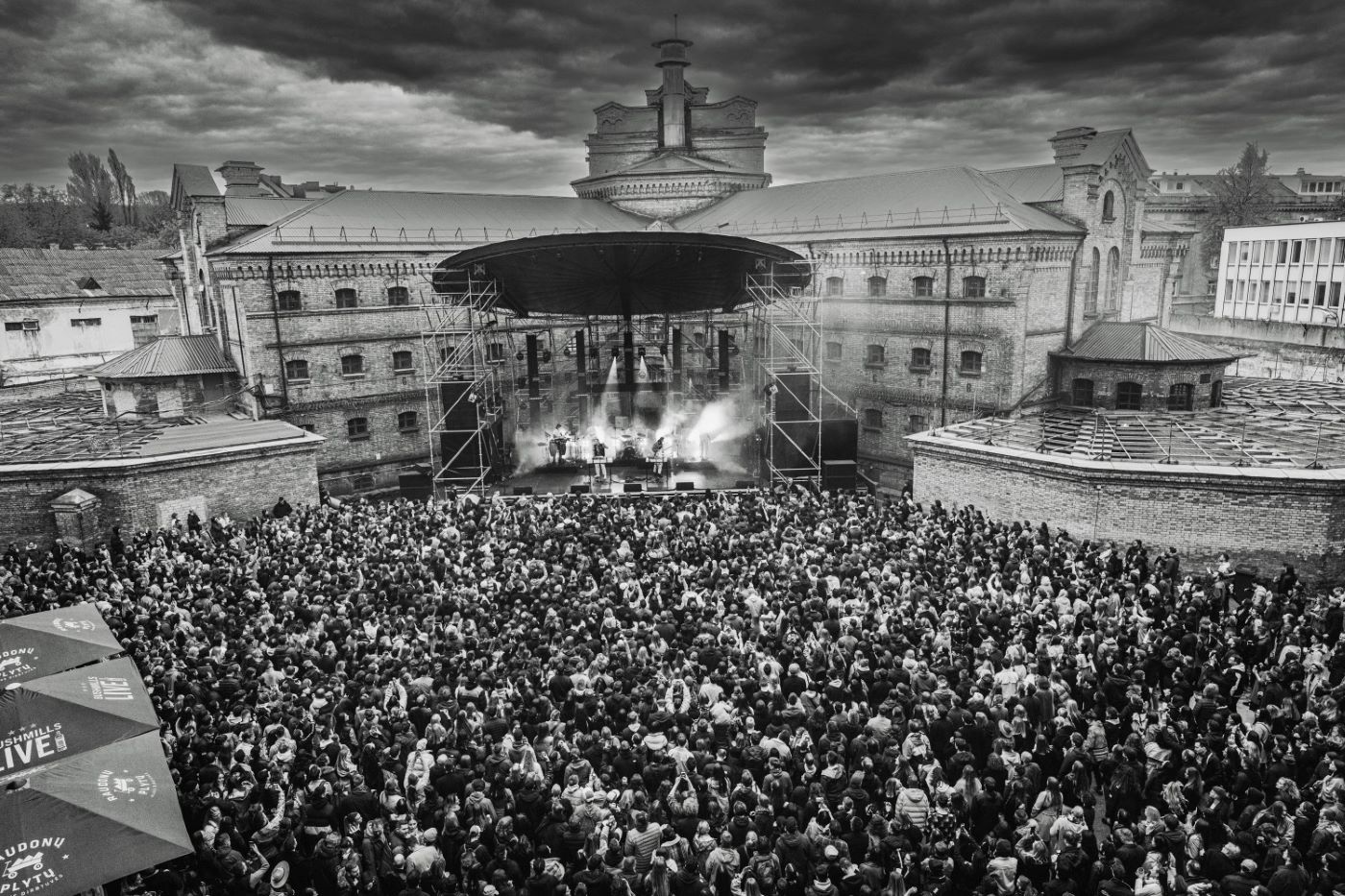
Outside, in the courtyard, a bass guitar soundcheck thrums against the yellow-brick walls. A food truck is unloading. Someone is stringing Edison bulbs between the guard towers.
Lukiškės Prison is the only former high-security prison in Europe sitting in the center of a capital city, a few hundred meters from the Lithuanian Parliament. For 115 years, Vilnius commuters walked past its walls on their way to work, ignoring the razor wire visible above the treetops. Every regime that conquered Lithuania — Tsarist, Polish, Nazi, Soviet — inherited this building and immediately filled it with new prisoners. The architecture never changed. The keys just passed to different hands. The building's thesis is written into its geography: power does not hide its instruments in Vilnius. It plants them at the city's heart, where everyone can see them and no one dares to look.
Lukiškės Prison Under the Russian Empire: Building a Panopticon in Vilnius (1837–1915)
The Old Monastery Prison and the Need for a Modern Facility
The original prison at Lukiškės predates the building that stands today. In 1837, Russian authorities converted a former Roman Catholic monastery in the Lukiškės suburb into a small criminal prison — adequate for an era when most punishment in the Empire took the form of katorga, forced resettlement to labor camps in Siberia. Serfs, who constituted most of the population, could be imprisoned by their own masters rather than the state. Formal prisons were almost an afterthought.
The 1874 revision of the Russian criminal code changed the calculus. New penalties — short-term and long-term prison confinement — demanded facilities that simply did not exist in the western provinces. By the 1890s, the old monastery prison was dilapidated and severely overcrowded. In 1900, the official architect of the Main Prison Authority, G.A. Trambitski, was tasked with designing a modern replacement.
The Panopticon Design and the Most Expensive Building in the Region
Trambitski's design, supervised by General Anatoliy Kelchevskiy, was modeled on Kresty Prison in St. Petersburg, itself inspired by Eastern State Penitentiary in Philadelphia and Moabit Prison in Berlin. The result was a modified panopticon — cell blocks radiating outward from a central observation point like the spokes of a wheel, ensuring that a single watchman could survey multiple corridors without inmates knowing whether they were being watched.
The complex, completed in 1904, covered an entire city block. It held cells for 421 penal inmates and 278 detainees awaiting trial, plus a bakery, bathhouse, ice cellar, laundry, and family apartments for the warden, four deputies, and 37 officers. Central heating, running water, modern plumbing, ventilation — for its moment, this was a state-of-the-art facility. It was also the most expensive building constructed in the Vilna Governorate in the early twentieth century. The plot required demolishing the old monastery prison and purchasing an adjacent Lipka Tatar cemetery for 20,000 roubles.
The prison's most distinctive feature reflected the religious diversity of Vilnius itself: an Orthodox church (St. Nicholas), a Catholic chapel, and a small synagogue were all built into the complex. The Tsars filled the cells with socialists, revolutionaries, and Lithuanian nationalists who dreamed of independence they would not live to see.
Lukiškės Between the Wars: From Polish Jurisdiction to Soviet Annexation (1918–1941)
The Prison Under Polish and Lithuanian Control
The collapse of the Russian and German Empires after World War I left Vilnius — and Lukiškės — caught in a territorial tug-of-war. Poland seized the city in 1920, and the prison fell under the jurisdiction of the Second Polish Republic for nearly two decades, holding political dissidents and common criminals while ethnic tensions between Poles, Lithuanians, and Jews simmered outside its walls.
Among the inmates of this era was Theodore Odrach, a Belarusian-Ukrainian writer imprisoned at the age of nine for stealing a chicken — a detail that captures the arbitrary cruelty of a system that made no meaningful distinction between desperation and criminality.
In October 1939, after the Soviet invasion of eastern Poland, Lithuania briefly reclaimed Vilnius and took administrative control of Lukiškės, replacing Polish staff with Lithuanian personnel. The transition was short-lived. On June 15, 1940, the Red Army crossed the border.
Menachem Begin and the NKVD Interrogation Cells
The Soviet annexation of Lithuania transformed Lukiškės overnight. The NKVD designated it Prison No. 2 and began mass arrests of Lithuanian nationalists, intellectuals, military officers, and anyone suspected of anti-Soviet sympathies. Over 17,000 Lithuanians were deported or imprisoned in the first year alone.
On September 20, 1940, NKVD agents arrested a 27-year-old Polish-Jewish Zionist leader named Menachem Begin — the future sixth Prime Minister of Israel and Nobel Peace Prize laureate. Begin had fled Warsaw after the German invasion in 1939 and was leading underground Betar activities in Vilnius. The Soviets accused him of being an “agent of British imperialism.”
Begin was brought to Lukiškės, where he endured the standard NKVD menu: sleep deprivation lasting days, freezing cells, and relentless interrogation sessions through the “white nights” that would later give his memoir its title. His interrogators demanded he acknowledge that Zionism was an anti-Soviet espionage operation. Begin refused to break. He would only sign a document confirming his participation in Zionist activities — nothing more. Unable to extract a false confession, the Soviets sentenced him to eight years of hard labor. On June 1, 1941, he was transferred to the Pechora labor camps in the Komi Republic, where he laid railway tracks in the Arctic cold. The German invasion of the Soviet Union, paradoxically, saved his life — Polish POWs were released under the Sikorski–Mayski Agreement, and Begin eventually reached Palestine.
His memoir, White Nights, ranks alongside Dostoevsky's House of the Dead and Solzhenitsyn's Gulag Archipelago as a masterwork of prison literature. The building where it began still stands, its corridors still cold.
Lukiškės Prison During World War II: The Antechamber of the Paneriai Massacre
The NKVD Massacres of June 1941
The German invasion of the Soviet Union on June 22, 1941, reached Vilnius within days. As Wehrmacht forces advanced, NKVD troops faced a choice: evacuate their prisoners or kill them. Across the western Soviet Union, the NKVD chose murder — executing an estimated 100,000 political prisoners in the span of weeks rather than risk their liberation. At Lukiškės, Soviet guards shot an unknown number of inmates before fleeing east. The pattern repeated across Lithuania: at Rainiai, near Telšiai, 79 political prisoners were tortured and killed. At Pravieniškės, near Kaunas, the NKVD murdered 260 prisoners along with all Lithuanian prison staff.
The retreating Soviets left behind cells still warm with the bodies of the people they had been “protecting” from fascism.
The Gestapo, the Vilna Ghetto, and the Road to Paneriai
The Nazis arrived at Lukiškės and immediately repurposed it — again — this time as a holding facility for the machinery of the Holocaust. The Gestapo and the Lithuanian Saugumas (Security Police) used the prison to process thousands of Jews rounded up from the Vilna Ghetto in mass łapankas — coordinated street sweeps where entire neighborhoods were emptied at gunpoint. Polish intellectuals and members of the Polish resistance, seized in retaliatory roundups, joined them in the overcrowded cells.
Vilnius had been known for centuries as the “Jerusalem of the North,” a city where an estimated 40 percent of the prewar population was Jewish, home to the YIVO Institute and a flourishing Yiddish intellectual culture. The Nazis and their local collaborators dismantled this in months. On September 6, 1941, 40,000 Jews were confined to the ghetto in the Old Town. The selections began immediately.
The first documented transport from Lukiškės to the killing pits occurred in July 1941: 348 Jews and others, loaded onto trucks for the ten-kilometer drive south to Paneriai. The pits had been dug by the Soviet military before the war for fuel storage — the Nazis found them ready-made. SS-Hauptscharführer Martin Weiss oversaw the Vilnius Special Unit (Sonderkommando), a squad of Lithuanian collaborators who carried out the shootings under German direction. The condemned were marched or driven along what is now Savanorių Avenue, past the Chapel of the Crucifixion on the Paneriai Hills — one of the last landmarks of the city visible before the forest swallowed them.
By the time the Vilna Ghetto was liquidated in September 1943, approximately 100,000 people — overwhelmingly Jewish, alongside Poles and Soviet POWs — had been murdered at Paneriai. More than 90 percent of Lithuania's Jewish population was annihilated. One synagogue remains in operation in Vilnius today.
As the war turned against Germany, the Nazis attempted to destroy the evidence. Lithuanian prisoners were forced to exhume and burn the corpses at Paneriai — an operation so grotesque that several of the forced laborers managed to escape through a tunnel they dug with their hands and spoons, emerging to tell the world what had been done.
Lukiškės Prison Under Soviet Occupation: The KGB Years (1944–1990)
The Return of the NKVD and the Forest Brothers
The Soviets recaptured Vilnius in July 1944 and reclaimed Lukiškės with the bureaucratic efficiency of a landlord reoccupying a vacated property. The NKVD — and later the KGB — immediately resumed filling the cells, this time with Polish Armia Krajowa partisans, Lithuanian nationalists, Catholic clergy, and anyone whose loyalty to the new order was suspect.
The most determined resistance came from the Forest Brothers — Lithuanian partisans who fought a guerrilla war against Soviet occupation from the forests of the countryside. Captured fighters were brought to Lukiškės for interrogation. The methods had not changed since Begin's time: sleep deprivation, isolation, cold, and the relentless pressure to sign confessions and name collaborators. Those who broke were sentenced to the Gulag. Those who refused were often executed. The last execution on prison grounds was carried out in 1995 — four years after Lithuanian independence.
Punitive Psychiatry and the Medical Wing
The Soviet occupation introduced a refinement to the arsenal of repression that required no firing squad. Dissidents who refused to accept the logic of the Communist state were frequently diagnosed with “sluggish schizophrenia” — a psychiatric classification that existed nowhere outside Soviet medical literature — and transferred to the medical wing.
The padded isolation cells in the basement levels of Lukiškės were not designed for treatment. They were designed for erasure. Inmates received drug-induced stupors that left them unable to form coherent thoughts, a chemical lobotomy administered under the pretense of care. The padded walls — stained, torn, their horsehair stuffing exposed — remain visible to visitors today. The rooms retain a stillness that the upper floors, now buzzing with artists and musicians, have shed.
The Closure of Lukiškės Prison and the Birth of Lukiškės 2.0 (2019–Present)
The Last Inmates Leave the Oldest Prison in the Baltics
On July 2, 2019, Lukiškės Prison closed. The Lithuanian government determined that the facility — overcrowded, poorly ventilated, and architecturally unchanged since 1904 — could not meet European Union standards for humane detention. Approximately 1,000 inmates were transferred to modern facilities. Some received only hours of notice. Calendars remained on cell walls, marking release dates that would now be counted down elsewhere. Personal items were left behind. The silence that settled over the complex was abrupt and total.
For 115 unbroken years — through five regimes, two world wars, one genocide, and one Cold War — the prison had never stopped operating. The gates had never been open.
From Dungeon to Cultural Hub: Artists, Bars, and the Reclamation Debate
The cultural agency 8 Days a Week was handed the keys and a mandate: transform the symbol of repression into something alive. The project was branded “Lukiškės 2.0.” The conversion was rapid. Administrative blocks became artist residencies. By 2026, over 500 artists, musicians, and creators occupied the complex — painting in former interrogation rooms, recording music in cells where the KGB had broken partisans.
The main exercise yard — where prisoners once marched in circles, forbidden from speaking — now hosts a bar. Food trucks line the perimeter. Strings of Edison bulbs crisscross overhead. You can order a craft IPA and sit at a picnic table. But look up. Just above the festive lights, the walls are still topped with coils of rusted razor wire. The guard towers still loom black against the night sky. You are drinking in a cage. The razor wire, once functional, has become decor — a backdrop for Instagram photos that carry a metallic aftertaste.
In December, the courtyard becomes a Christmas market. Families bring children to meet Santa Claus in a place where children were once stripped from their parents. Snow softens the angles of the brick and covers the grime of the yard. A cup of mulled wine, the sound of carols — and then, through a window, the heavy iron bars of a solitary confinement cell. The illusion shatters.
The Stranger Things Effect and the Ethics of Entertainment
Global recognition arrived through fiction. In 2020 and 2021, Netflix filmed scenes for Season 4 of Stranger Things at Lukiškės, using the prison as a stand-in for a Soviet labor camp in Kamchatka. The snowy courtyard, the tiered cell blocks, the claustrophobic corridors — none of it was built on a soundstage. Fans now visit “Hopper's Cell.” In 2022, the Vilnius tourism agency offered a Stranger Things-themed cell on Airbnb for €107 a night, drawing immediate backlash from groups who argued it trivialized the prison's role in the Holocaust.
The irony is precise but uncomfortable. American pop culture has repackaged the aesthetics of Soviet repression as sci-fi entertainment, layering fictional horror over real suffering. The guides lean into it — you can stand where the Demogorgon tore through guards. But the fictional guards occupied the same corridors as the very real NKVD officers who shot prisoners in June 1941, and the very real Gestapo agents who processed Jews for Paneriai.
The generational divide in Vilnius is stark. Older Lithuanians, some of whom remember Soviet repression firsthand, view the concerts and craft cocktails as desecration. The younger generation and the artists who now inhabit the space argue the opposite: that leaving the building empty and silent is to let the oppressors win. Every techno beat that vibrates against the prison walls, they contend, is a sonic defiance of the regimes that built them. Every painting created in a former cell is creation winning over destruction. Neither side is entirely wrong.
Visiting Lukiškės Prison — The Atlas Entry
What to Expect at Lukiškės Prison Today
Lukiškės Prison 2.0 is open to the public year-round. Guided tours of the historic wings — including the detention blocks, interrogation rooms, the Orthodox church, and the medical wing — run approximately two hours and are available in English, Lithuanian, and Russian. Day tours start at approximately €15; night tours, which use only flashlights and lean into the psychological weight of the unrestored wings, cost around €20. The exhibitions and bars are typically open from noon to midnight.
The night tour deserves specific mention. Without the distraction of daylight and the bustle of the creative hub, the panopticon architecture reasserts itself. The central rotunda creates a sensation of constant exposure. The corridors are cold. The beam of a flashlight catches dust in the stagnant air of basement cells that haven't been heated since the last prisoners left. Whether or not you believe in ghosts, the psychological residue of 115 years of incarceration is palpable in the silence.
The prison is located at Lukiškių skg. 6, a short walk from Gediminas Avenue and the Lithuanian Parliament. Direct flights to Vilnius are available from most major European cities.
Vilnius's Darker Layers — Nearby Sites of Memory
Lukiškės sits within a broader geography of occupation and remembrance. The Museum of Occupations and Freedom Fights (Vabamu), housed in the former KGB headquarters on Gedimino prospektas, provides essential context on Lithuania's twentieth-century suffering. The Paneriai Memorial, ten kilometers south, marks the killing pits where approximately 100,000 people were murdered — the direct destination of the prisoners who left Lukiškės and never returned.
Across the Baltic states, a triangle of Soviet-era prisons tells a parallel story. Patarei Prison in Tallinn, Estonia — a sea fortress that held prisoners under three successive regimes — mirrors Lukiškės almost exactly in its timeline of occupation and repurposing. Karosta Prison in Liepāja, Latvia, a former tsarist naval brig, now offers overnight “prisoner experience” stays in its cells. Further afield, the Stasi Prison at Berlin-Hohenschönhausen demonstrates how the Soviet model of psychological imprisonment was exported to East Germany, while Plokštinė missile base in Lithuania's forests reveals the nuclear infrastructure that accompanied the repressive apparatus.
The building at Lukiškės offers no redemption arc. The razor wire is still there, even if Edison bulbs now hang below it. The panopticon still works, even if the watchers are tourists with iPhones. The question Lukiškės poses is not whether the past can be overcome — it is whether joy and memory can occupy the same square meter of concrete without one erasing the other. Five regimes tried to answer that question with force. Vilnius, characteristically, is trying to answer it with music.
Frequently Asked Questions
What was Lukiškės Prison originally built for?
Lukiškės Prison was constructed between 1900 and 1904 under the Russian Empire as a modern high-security facility to replace an overcrowded monastery prison dating to 1837. Designed by architect G.A. Trambitski and modeled on Kresty Prison in St. Petersburg, it featured a panopticon layout with radial cell blocks, central heating, running water, and capacity for nearly 700 inmates. It was the most expensive building constructed in the Vilna Governorate at the time.
What happened at Lukiškės Prison during World War II?
The prison's World War II history unfolded in two distinct phases. In June 1941, as German forces advanced, retreating Soviet NKVD troops executed prisoners rather than allow their liberation — part of a broader pattern of NKVD massacres across the western Soviet Union. Under subsequent Nazi occupation (1941–1944), the Gestapo used Lukiškės as a transit facility for Jews rounded up from the Vilna Ghetto, Polish resistance members, and other targeted groups. Thousands were held in the prison before being transported to the Paneriai killing pits, where approximately 100,000 people were murdered.
Who was the most famous prisoner held at Lukiškės?
Menachem Begin, who later became the sixth Prime Minister of Israel and a Nobel Peace Prize laureate, was arrested by the Soviet NKVD on September 20, 1940, and detained at Lukiškės. Accused of being a British intelligence agent due to his leadership of the Zionist Betar movement, Begin endured prolonged interrogation including sleep deprivation and freezing conditions. He documented his imprisonment in the memoir White Nights, considered a masterwork of prison literature. He was sentenced to eight years of hard labor and transferred to Arctic camps in June 1941.
Can you visit Lukiškės Prison today?
Lukiškės Prison closed as a functioning penitentiary in July 2019 and reopened as “Lukiškės 2.0,” a cultural hub managed by the agency 8 Days a Week. Guided historical tours lasting approximately two hours are available in English, Lithuanian, and Russian, with day tours from €15 and night tours from €20. The complex also houses over 500 artist studios, bars, exhibition spaces, and hosts concerts and seasonal events including a Christmas market.
Was Lukiškės Prison used as a filming location?
Lukiškės served as the primary filming location for the Russian prison camp scenes in Season 4 of the Netflix series Stranger Things (2022). The production used the prison's authentic Soviet-era architecture — the courtyard, cell blocks, and corridors — without needing to construct sets. A subsequent Airbnb promotion offering a Stranger Things-themed cell for €107 per night drew controversy from groups who felt it trivialized the prison's wartime history.
What is the debate about Lukiškės Prison's transformation?
The conversion of Lukiškės into a cultural venue has divided Lithuanian society along generational lines. Older residents, particularly those with personal or family memories of Soviet repression, view concerts and bars in the prison as disrespectful to victims. Younger Lithuanians and the resident artist community argue that filling the space with creativity and life is an act of reclamation — that silence and abandonment would grant the oppressive regimes a posthumous victory. The tension remains unresolved and is part of what makes a visit to Lukiškės a genuinely challenging experience.
Sources
- Hitler's Death Squads: The Logic of Mass Murder — Helmut Langerbein, Texas A&M University Press (2003)
- White Nights: The Story of a Prisoner in Russia — Menachem Begin (1957)
- Genocide and Resistance Research Centre of Lithuania — Archival records on Soviet and Nazi occupation of Lithuanian prisons
- Vilnius Jewish Community Archives — Documentation of the Vilna Ghetto and Paneriai massacres
- The Prime Ministers — Yehuda Avner, Toby Press (2010)
- Prisons in the Baltic States — Dartmouth College, comparative study of Lukiškės, Patarei, and Karosta
- National Geographic Travel: How This Lithuanian Prison Became a Stronghold of Art and Festivals (2025)
- The Times of Israel: 'Stranger Things' Filmed in Lithuania Jail Where Nazis Held Jews (2022)
- Neakivaizdinis Vilnius: Memorial Road to Paneriai (1941–1944) — Zigmas Vitkus, Klaipėda University
- Go Vilnius Tourism Portal — Lukiškės Prison 2.0 official visitor information