The Five-Minute Suicide Charge That Saved the Union Line at Gettysburg
Late afternoon, July 2, 1863. A mile-wide gap has opened in the Union line on Cemetery Ridge. The III Corps has collapsed under Confederate assault, and roughly 1,200 troops from Cadmus Wilcox’s Alabama brigade are pouring through the breach. The only unit close enough to stop them is the 1st Minnesota Volunteer Infantry — 262 men standing in a shallow depression, watching the gray mass roll toward them across the valley.
General Winfield Scott Hancock galloped up on horseback, scanning the line for anyone he could throw into the gap. He pointed at the Minnesotans. “What regiment is this?” Colonel William Colvill answered: “First Minnesota.” Hancock did not explain. “Charge those lines.” Every man in the regiment understood what the order meant. They fixed bayonets and ran downhill at double-quick into concentrated rifle fire. The regimental flag fell. A corporal dropped his weapon to grab it. He was shot. Another man seized it. Five flag bearers went down in five minutes. Within those minutes, 215 of the 262 were killed or wounded — an 82% casualty rate, the highest sustained by any surviving regiment in the entire war. The 47 men who walked back to the Union line had bought Hancock the time he needed. The gap was closed. The line held.
Gettysburg is the place where the question of whether the United States would continue to exist was answered not by generals or politicians but by the bodies of ordinary men stacked in fields, orchards, and ravines over three days of killing that neither side had planned and neither could stop. The battle was an accident. Neither army intended to fight here. A Confederate foraging party stumbled into Union cavalry on the Chambersburg Pike on the morning of July 1, and within hours the collision dragged both armies — 93,000 Union, 71,000 Confederate — into a fight that would determine whether the American experiment survived its first century. What happened over the next 72 hours produced the largest number of casualties in any battle on American soil, destroyed the offensive capacity of Lee’s army, and gave Abraham Lincoln the moral platform to redefine the war as a fight not just for union but for human equality.
Why Lee Invaded the North in the Summer of 1863
By the spring of 1863, the Confederacy was winning battles but losing the war. Robert E. Lee’s Army of Northern Virginia had crushed the Union at Chancellorsville in May, but the victory cost him Stonewall Jackson, shot by his own men in the twilight and dead of pneumonia within days. The Confederate economy was collapsing under the Union naval blockade. Food prices in Richmond had triggered bread riots. Vicksburg, the last Confederate stronghold on the Mississippi, was under siege by Ulysses S. Grant.
Lee proposed a gamble: take the war north. An invasion of Pennsylvania would feed his army on Northern crops, relieve pressure on Vicksburg, and — if he could destroy the Army of the Potomac on its own soil — potentially force the Lincoln administration to negotiate. The Confederate government approved. In June, 71,000 men began marching north through the Shenandoah Valley into Maryland and Pennsylvania. The residents of Gettysburg, a small crossroads town surrounded by wheat fields and peach orchards, had no idea they were standing at the intersection of ten roads that both armies would converge on simultaneously.
Three Days That Killed 50,000 Men on Pennsylvania Farmland
July 1 — The Accidental Collision and the Death of a General
The battle began as a skirmish. Confederate infantry from A.P. Hill’s corps, marching toward Gettysburg in search of supplies, ran into Union cavalry under John Buford on the morning of July 1. Buford’s troopers, armed with repeating carbines, held the ridgeline west of town long enough for Union infantry to arrive. The first senior officer on the field, Major General John Reynolds — considered the best corps commander in either army — was killed within the first hour, a bullet striking behind his left ear as he directed troops into McPherson’s Woods. He fell from his horse without speaking.
The fighting escalated through the morning as both sides fed reinforcements into a battle neither had planned. By afternoon, the Confederates had driven the Union forces through the streets of Gettysburg itself — civilians watching from windows as soldiers fought and died on their front lawns — and onto the high ground south of town: Cemetery Hill, Cemetery Ridge, and the two rocky hills called the Round Tops. The Union line settled into a shape that military historians would later call “the fishhook,” a compact defensive arc with interior lines that allowed rapid reinforcement. Lee’s forces wrapped around the outside. The geometry of the next two days was set.
July 2 — The Afternoon That Nearly Broke the Union Army
The second day produced the war’s most concentrated violence. Lee ordered simultaneous attacks on both ends of the Union line — James Longstreet’s corps against the Union left at the Round Tops, Richard Ewell’s corps against the Union right at Culp’s Hill and Cemetery Hill.
The crisis came on the Union left. General Daniel Sickles, commanding the III Corps, had advanced his troops a half-mile forward of the main line without orders, occupying a salient around a peach orchard that looked tactically appealing but was indefensible. When Longstreet’s assault hit, Sickles’ exposed position crumbled. The fighting in the Wheatfield and the Peach Orchard became a grinding horror — the Wheatfield changed hands six times in a single afternoon, each exchange leaving another layer of dead. Sickles himself took a cannonball to the right leg. He was carried off the field on a stretcher, reportedly smoking a cigar to reassure his men. He later donated the amputated limb to the Army Medical Museum in Washington and visited it regularly for the rest of his life.
The collapse of Sickles’ line tore a gap in the Union center — the gap that the 1st Minnesota was sacrificed to close. Simultaneously, on the extreme Union left, the defense of Little Round Top came down to one regiment. Colonel Joshua Lawrence Chamberlain’s 20th Maine held the end of the line against repeated uphill assaults by the 15th Alabama. Ammunition ran out. Chamberlain, facing a final charge with empty rifles, ordered a bayonet attack — the entire regiment surging downhill into the startled Confederates. The charge swept the slope, captured dozens of prisoners, and saved the Union flank. Chamberlain received the Medal of Honor. The men who fought beside him would have traded the recognition for the friends they left on that hillside.
July 3 — Pickett’s Charge and the High Water Mark
Lee believed two days of fighting had weakened the Union center enough to break it. He ordered the largest infantry assault of the war: nearly 12,500 men — George Pickett’s Virginia division in the center, flanked by brigades under James Pettigrew and Isaac Trimble — would cross three-quarters of a mile of open ground and storm Cemetery Ridge.
A two-hour artillery bombardment preceded the attack, over 150 Confederate guns firing simultaneously in a cannonade heard as far as Pittsburgh. The barrage was a failure. Most rounds overshot the Union line entirely. Union artillery chief Henry Hunt ordered his guns to stop firing — a deliberate deception to convince the Confederates their bombardment had worked. It did. At approximately 2:00 PM, the Confederate infantry stepped out of the tree line on Seminary Ridge and began walking.
They marched in formation across open fields, uphill, with no cover. Union artillery opened with solid shot, then shell, then canister — tin cans packed with iron balls that turned each cannon into a giant shotgun. The lines staggered, re-formed, staggered again. Men fell in clusters. General Lewis Armistead, leading the furthest penetration, crossed the low stone wall at a place called the Angle with perhaps 200 men. He placed his hand on the barrel of a Union cannon — the symbolic “High Water Mark of the Confederacy” — and was shot. He died two days later in a Union field hospital. The breach was sealed within minutes. The survivors stumbled back across the field. Lee rode out to meet them. “All this has been my fault,” he told the shattered remnants.
The Town That Became a Morgue — Gettysburg After the Guns Stopped
7,000 Dead, 3,000 Horses, and the Smell That Carried for Miles
The armies moved on. The dead did not. On July 4 — Independence Day — the town of Gettysburg woke to silence and the beginning of a catastrophe that would take months to resolve. Roughly 7,000 men lay dead across the fields, orchards, and rocky outcrops surrounding the town. Another 33,000 wounded from both sides filled every structure within miles. Every church, barn, schoolhouse, and private home became a hospital. Surgeons worked around the clock with no antiseptics, no germ theory, and dwindling chloroform. Amputation was the default procedure for any serious limb wound — piles of severed arms and legs accumulated outside windows and doorways, attracting clouds of flies in the July heat.
The 3,000 horse carcasses were the first emergency. Dead horses bloat rapidly in summer, and within days the stench was detectable miles from town. Residents burned them in massive pyres that blackened the sky. The human dead took longer. Shallow burials — often just a few inches of dirt kicked over a body where it fell — were the initial solution. Rain washed the soil away. Dogs and hogs disturbed the graves. For weeks, the landscape around Gettysburg was a decomposing horror that no one who witnessed it ever fully described in writing, though many tried.
Tillie Pierce, Jennie Wade, and the Civilians Trapped in the Crossfire
Tillie Pierce was fifteen years old when the battle began. She had been sent to a neighbor’s farm on the Taneytown Road, assumed to be safely behind the lines. The lines moved. By the second day, the farm sat in the middle of the fighting near the Round Tops. Tillie spent three days carrying water to wounded soldiers, watching amputations performed on kitchen tables, and stepping over bodies in hallways. Her memoir, published decades later, remains one of the most vivid civilian accounts of the battle — not because she witnessed the tactical movements that military historians obsess over, but because she described what it felt like to be a child watching men die in rooms where she had once eaten dinner.
Jennie Wade was the only civilian killed during the battle. A stray bullet passed through two doors of her sister’s house on Baltimore Street on the morning of July 3, striking her in the back while she kneaded bread. She was 20 years old.
The town’s free Black residents faced a terror that went beyond artillery. Confederate troops operating under orders — or at least with the tolerance of their officers — seized African Americans during the invasion and sent them south into slavery. Mag Palm, a free Black woman living in Gettysburg, was among those taken. The number kidnapped from the Gettysburg area during Lee’s invasion remains disputed, but contemporary accounts confirm that it happened systematically across southern Pennsylvania. For Black residents of Gettysburg, the battle was not an abstraction about union and secession. It was men with rifles coming to their doors.
The Gettysburg Address — 272 Words That Redefined Why the War Was Being Fought
Four months after the battle, on November 19, 1863, Abraham Lincoln traveled to Gettysburg for the dedication of the Soldiers’ National Cemetery. He was not the main speaker. That honor went to Edward Everett, the most celebrated orator in America, who delivered a two-hour address that covered the battle in exhaustive detail. Almost no one remembers a word of it.
Lincoln spoke for roughly two minutes. His 272 words did not describe the battle. They did not name a single soldier, regiment, or commander. Instead, Lincoln reframed the entire war. The conflict was no longer simply about preserving the Union — it was a test of whether a nation “conceived in liberty and dedicated to the proposition that all men are created equal” could survive. The dead at Gettysburg had not died for a political arrangement. They had died for an idea. Lincoln made their sacrifice the moral foundation of a new American identity, one that the country would spend the next century and a half struggling to live up to.
The speech was not universally praised at the time. Several newspapers dismissed it as inadequate for the occasion. Everett, to his credit, wrote to Lincoln the next day: “I should be glad if I could flatter myself that I came as near to the central idea of the occasion in two hours as you did in two minutes.” The assassination of Lincoln at Ford’s Theatre less than two years later would seal the Address as sacred text — the words of a martyred president spoken over the graves of men who died for the cause he was murdered for advancing.
What Gettysburg Became — Monuments, Memory, and the Battles Over the Battle’s Meaning
The battlefield was among the first in America to be preserved. By the 1890s, veterans from both sides were returning to dedicate monuments — over 1,300 now stand across the landscape, making Gettysburg the most monumented battlefield in the world. The 50th anniversary reunion in 1913 brought together Union and Confederate survivors, now elderly men in their seventies, who shook hands across the stone wall at the Angle where they had once tried to kill each other. President Woodrow Wilson addressed the gathering with a speech about national reconciliation — a reconciliation built, critics would later note, on the erasure of slavery as the war’s cause and the abandonment of Black civil rights in the Jim Crow South.
That tension — between Gettysburg as a story of American valor and Gettysburg as a story of what that valor was actually for — has never been resolved. The battlefield’s interpretive programs have shifted over the decades from purely military analysis toward a fuller reckoning with slavery, emancipation, and the experience of civilians and African Americans. The monuments themselves remain frozen in the assumptions of the era that built them — overwhelmingly honoring white soldiers, with the Confederacy’s participation framed as a matter of courage rather than cause. The landscape is both a memorial and an argument, and the argument is still ongoing.
Visiting Gettysburg National Military Park — The Atlas Entry
Walking the Battlefield and the Path of Pickett’s Charge
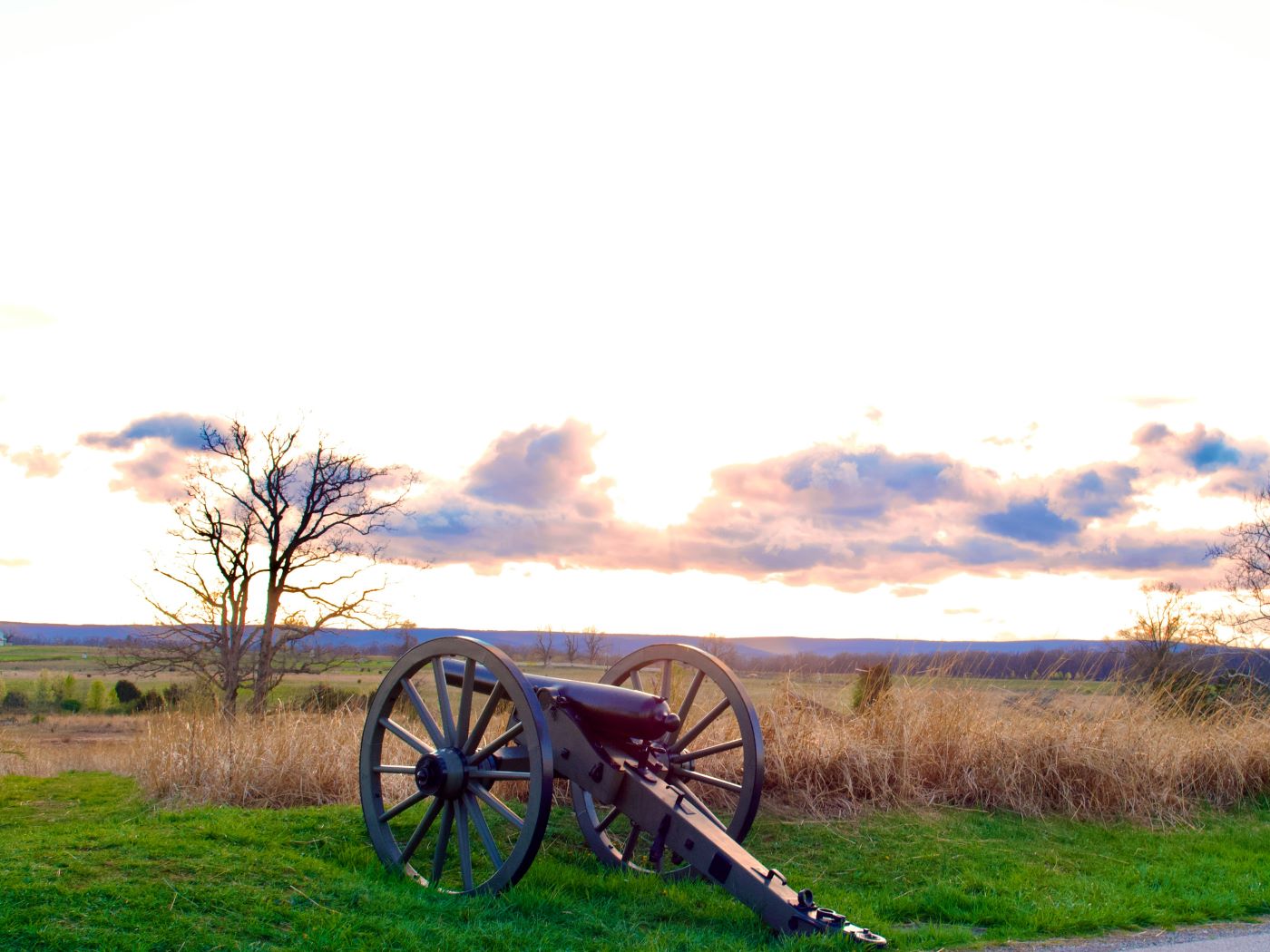
Gettysburg National Military Park covers more than 6,000 acres of rolling Pennsylvania farmland, and the scale of the battlefield is its most disorienting feature. The visitor center, operated by the National Park Service, houses the restored Gettysburg Cyclorama — a 360-degree painting from 1884 that depicts Pickett’s Charge at a scale that photographs cannot replicate. The museum’s collection includes weapons, personal effects, and medical instruments that make the war’s physical reality unavoidable.
The battlefield itself can be toured by car along a 24-mile auto route, but the place only makes sense on foot. Walking the path of Pickett’s Charge — from the Confederate starting position on Seminary Ridge, across the open fields, to the stone wall at the Angle — takes roughly 15 minutes at a normal pace. The distance is absurdly short. Three-quarters of a mile. The ground rises gently. There is no cover at all. Standing in those fields, looking up at the ridge where the Union guns were positioned, the mathematics of the charge become visceral in a way that no book or documentary can achieve. The men who walked this ground in formation, into canister fire, knowing what was happening, are impossible to comprehend and impossible to forget.
The Cemetery, the Headstones, and What Silence Sounds Like at Gettysburg
The Soldiers’ National Cemetery sits on the hill where Lincoln delivered the Address. The graves are arranged in concentric arcs by state — a geography of loss radiating outward from a central monument. Many headstones carry only a number: “Unknown.” Others bear inscriptions added later by families who found their dead: “Our only son.” The Confederate dead are not here. They were exhumed in the 1870s and reinterred in cemeteries across the South — Richmond, Raleigh, Savannah, Charleston — a postwar project funded by Southern women’s memorial associations who refused to leave their dead in Northern soil.
Gettysburg is best visited in the early morning or late autumn, when the tour buses thin out and the fields go quiet. The monuments cast long shadows across ground that looks like any other Pennsylvania farmland — gentle hills, split-rail fences, the occasional deer. The battlefields of Verdun share this quality: landscapes so ordinary that the violence they absorbed feels impossible until you stand on them. The same dissonance haunts Omaha Beach and Gallipoli — places where the gap between what the ground looks like and what happened on it is the point. Gettysburg does not shout. It does not need to. The names on the stones do the work.
Frequently Asked Questions About the Battle of Gettysburg
Why is Gettysburg considered the turning point of the Civil War?
Gettysburg ended Robert E. Lee’s second and final invasion of the North. The Confederate defeat on July 3, 1863 — combined with the fall of Vicksburg to Ulysses S. Grant the following day — shattered the Confederacy’s last realistic chance of winning the war through a decisive military victory on Northern soil. Lee’s army never recovered the offensive capacity it carried into Pennsylvania. The Army of Northern Virginia spent the remaining two years of the war on the defensive, and Lee himself acknowledged the failure by offering his resignation to President Jefferson Davis, who refused it.
How many people died at the Battle of Gettysburg?
Total casualties across three days exceeded 50,000 — approximately 23,000 Union and 28,000 Confederate soldiers killed, wounded, captured, or missing. Of these, roughly 7,000 to 8,000 were killed outright or died of wounds shortly after the battle. The toll exceeded the total American losses of the entire Revolutionary War and made Gettysburg the deadliest battle ever fought in the Western Hemisphere.
What was Pickett’s Charge and why did it fail?
Pickett’s Charge was the Confederate assault on the Union center at Cemetery Ridge on July 3, 1863. Nearly 12,500 men marched three-quarters of a mile across open ground, uphill, with no cover, into concentrated artillery and rifle fire. The charge failed because the preceding two-hour artillery bombardment largely overshot the Union line, leaving the defenders intact. Union artillery chief Henry Hunt had deliberately ceased firing to deceive the Confederates into believing their bombardment had succeeded. The assault resulted in roughly 50% casualties and is often called the “High Water Mark of the Confederacy.”
What did Abraham Lincoln say in the Gettysburg Address?
Lincoln’s 272-word speech, delivered on November 19, 1863, at the dedication of the Soldiers’ National Cemetery, reframed the Civil War as a test of whether a democratic nation “conceived in liberty and dedicated to the proposition that all men are created equal” could endure. He did not describe the battle or name any participants. Instead, he argued that the soldiers’ sacrifice had created a moral obligation for the living to ensure “that government of the people, by the people, for the people, shall not perish from the earth.”
Can you visit the Gettysburg battlefield today?
Gettysburg National Military Park is open year-round and managed by the National Park Service. The park covers more than 6,000 acres and contains over 1,300 monuments. Visitors can follow a 24-mile auto tour, explore the museum and visitor center, view the restored 1884 Cyclorama painting, and walk key sites including Little Round Top, the Angle, and the Soldiers’ National Cemetery. Licensed battlefield guides offer private tours. The park is free to enter; there is a fee for the museum and Cyclorama.
What happened to the civilians of Gettysburg during the battle?
The town’s 2,400 residents were trapped in a three-day battle they had no warning of. Every building became a hospital. Fifteen-year-old Tillie Pierce spent the battle carrying water to wounded soldiers and witnessing amputations. Jennie Wade, age 20, was the only civilian killed — struck by a stray bullet while kneading bread in her sister’s kitchen. Free Black residents faced an additional horror: Confederate troops systematically seized African Americans and sent them south into slavery during the invasion of Pennsylvania.
Sources
- [The Killer Angels] - Michael Shaara (1974)
- [Gettysburg: The Last Invasion] - Allen C. Guelzo (2013)
- [Battle Cry of Freedom: The Civil War Era] - James McPherson (1988)
- [At Gettysburg, or What a Girl Saw and Heard of the Battle] - Tillie Pierce Alleman (1889)
- [Gettysburg: A Testing of Courage] - Noah Andre Trudeau (2002)
- [The Gettysburg Address: Perspectives on Lincoln’s Greatest Speech] - Sean Conant, ed. (2015)
- [First Minnesota at Gettysburg] - Minnesota Historical Society Collections
- [Disgust, Decay, and Dead Horses: The Aftermath of Gettysburg] - National Park Service Interpretive Resources
- [African Americans and the Gettysburg Campaign] - Margaret Creighton, “The Colors of Courage” (2005)
- [Lee’s Real Plan at Gettysburg] - Troy D. Harman (2003)